
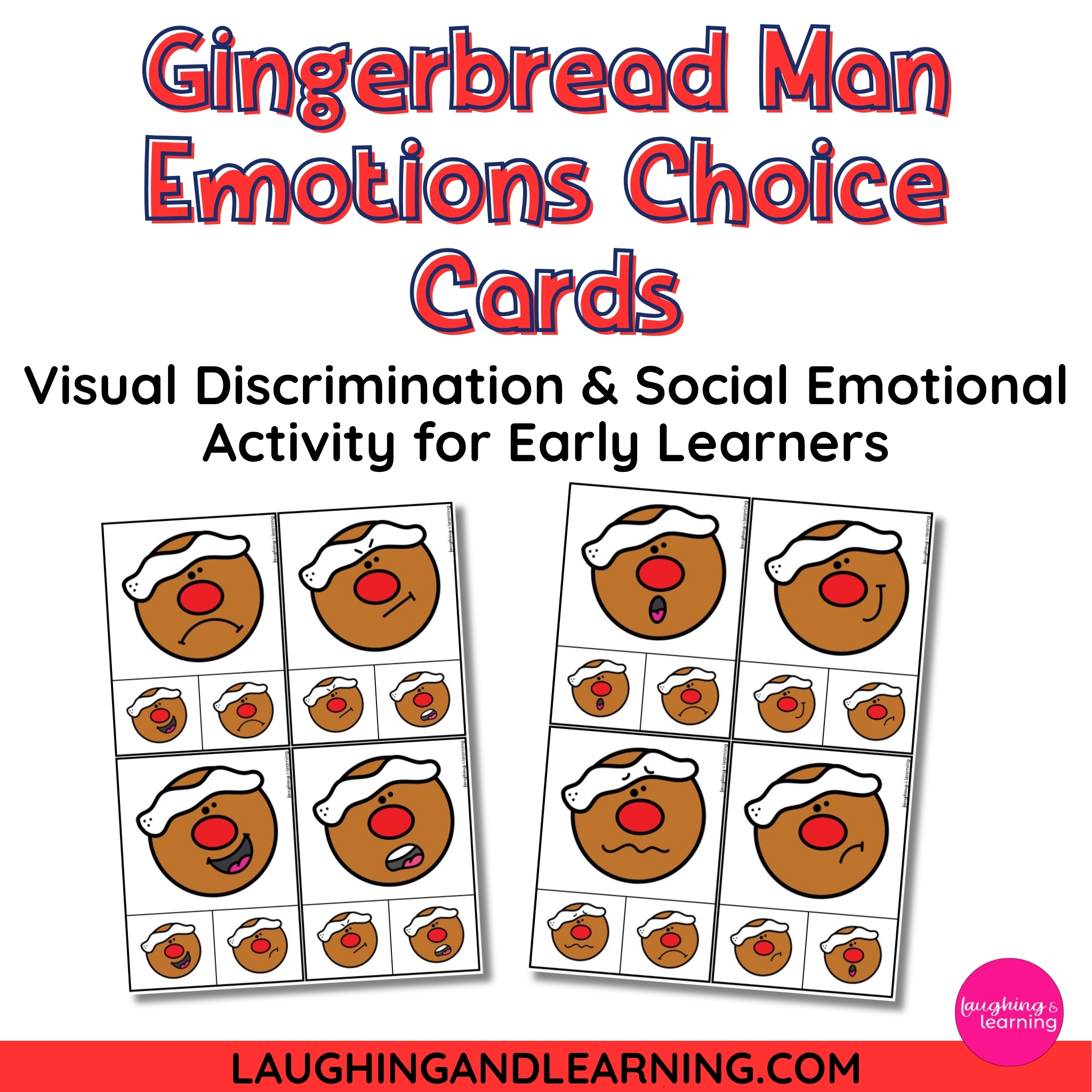
The holiday season brings so much excitement into the classroom. It also brings big feelings that little ones are still learning to name. Gingerbread man emotions choice cards turn that learning into a cheerful, hands-on activity. Children match a large gingerbread man face to its identical twin among smaller choices. Along the way, they practice spotting subtle facial differences and talking about how each expression feels.
This activity fits right into a busy December centers rotation. It works for whole group lessons, small group instruction, or independent practice. Best of all, it pairs visual discrimination with real social-emotional learning, so every match becomes a chance to talk about feelings.
What Are Gingerbread Man Emotions Choice Cards

Gingerbread man emotions choice cards are a matching activity built around a favorite holiday character. Each card features one large gingerbread man face showing a clear emotion, such as happy, sad, angry, surprised, worried, or silly. Below that face sit two smaller gingerbread man options. Only one of those smaller faces matches the large one exactly.
Children scan the choices, compare eyebrows, mouths, and eyes, then pick the matching expression. The cards are simple enough for a first introduction to emotions vocabulary. They also offer enough visual challenge to keep older preschoolers and kindergartners engaged. Print on cardstock and laminate for a durable, reusable resource that holds up through the whole holiday season.
Ways to Use the Gingerbread Man Emotions Choice Cards
There is more than one way to bring this activity into your classroom. Try starting simple, then build in language and movement as children grow more confident.

Core match- Ask the learner to find the small face that matches the large gingerbread man exactly. This is the foundation activity and works well for first-time users.
Find the different one- Flip the challenge by asking children to spot the gingerbread man face that does not belong. This variation strengthens close visual comparison skills.
Feel and tell- After each match, invite the child to name the feeling out loud. Add a sentence stem like “I feel angry when…” to connect the emotion to real experience.
Act and match- One child acts out an emotion with their own face. Classmates find the matching gingerbread man card and say the feeling aloud. A small mirror nearby lets children check their own expressions too.
Skills This Emotions Activity Builds

These cards target several developmental areas at once, making them a strong addition to any early learning toolkit.
Visual discrimination- Children practice noticing small differences in eyebrows, mouth shape, and eyes. This scanning skill supports early reading readiness.
Emotion vocabulary- Repeated exposure to words like frustrated, proud, and surprised helps children build a richer feelings vocabulary over time.
Working memory- Comparing several small faces against one large face asks children to hold visual details in mind while they search.
Empathy and perspective-taking- Talking through when a feeling shows up, and what helps in that moment, builds early empathy and self-regulation language.
Differentiation for Every Learner

Narrow the field- Start new learners with just three or four core emotions. Add trickier look-alike expressions once they feel confident with the basics.
Visual supports- Keep emotion word cards or simple eyebrow and mouth icons nearby for children who need an extra cue. Fade these supports as skills grow.
Think-alouds- Model the exact clues you notice, such as “eyebrows slanted in means angry” or “eyebrows high with an open mouth means surprised.” This gives children the language to do the same noticing on their own.
Preparation Tips
- Print the gingerbread man emotions choice cards on cardstock for lasting durability.
- Laminate each page so the set can be wiped clean and reused season after season.
- Cut along the trim guides to separate each card cleanly.
- Store the finished set in a labeled bin or folder for quick access during centers.
- Keep a small mirror nearby if you plan to use the act-and-match variation.
Why This Emotions Activity Works

Young children often feel big emotions before they have the words to explain them. Giving children a playful, low-pressure way to practice naming feelings builds a skill they will use for life. The gingerbread man emotions choice cards wrap that important work inside a festive character kids already love. Because the activity blends visual discrimination with feelings talk, it supports both academic readiness and social-emotional growth in a single, simple resource.
The open-ended format also means teachers can adjust the challenge on the fly. A child who needs more support can stick with the core matching task. A child ready for more can move into the odd-one-out or acting variations. That flexibility makes this one resource useful across a whole classroom of different skill levels.
Get the Gingerbread Man Emotions Choice Cards

Ready to bring feelings recognition into your holiday lineup? The gingerbread man emotions choice cards are available now, complete with trim guides and a full instruction sheet for quick, no-fuss prep.
Perfect for preschool, pre-K, and kindergarten classrooms serving children ages 3–6.
Looking for More Festive Activities?
If your learners enjoy these Gingerbread Man Emotions Choice Cards, you will find many more hands-on resources in the Laughing & Learning shop. Happy learning!
If you use this in your classroom or at home, I’d love to hear how it went! Drop a comment below or tag me on Instagram. 🌸
Leave a Reply