
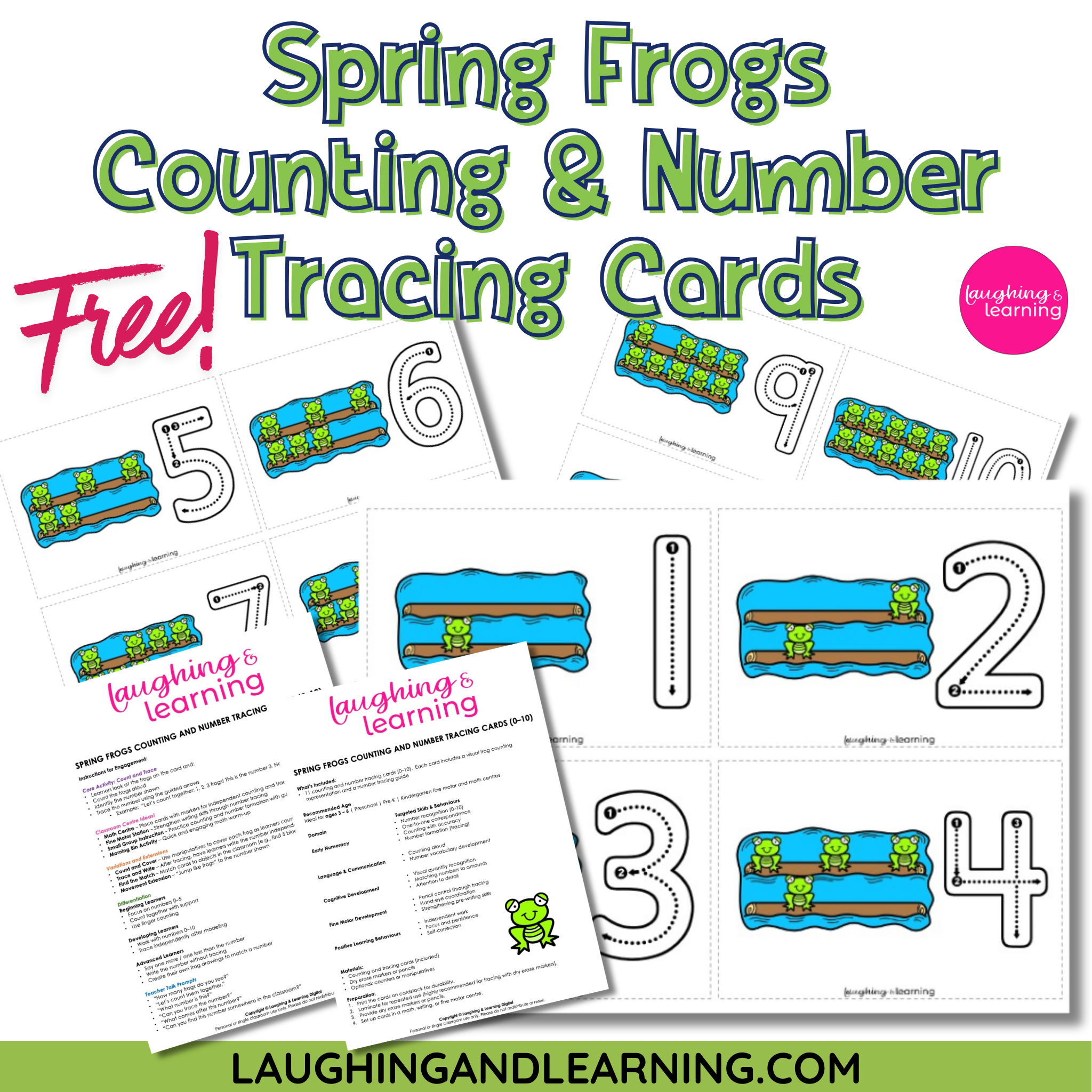
If you’re looking for fun spring counting cards that build early number sense and fine motor skills at the same time, you are going to love these Spring Frogs Counting and Number Tracing Cards! This free printable is perfect for preschool, pre-K, and kindergarten classrooms, homeschool settings, and spring literacy and math centres. Learners count the adorable frogs sitting on a log, identify the number, and then trace it using the guided dotted arrows, all in one engaging, low-prep activity.
Whether you’re setting up a math centre for April, looking for a spring morning bin activity, or simply need a fresh way to practice number formation with your little learners, these cards are a print-and-go solution that children absolutely love.
Why Counting and Tracing Activities Matter in Early Childhood
Before we dive into the activity itself, let’s talk about why combining counting with number tracing is such a powerful approach for early learners.
Young children develop number sense in stages. First, they learn to count objects one by one (one-to-one correspondence). Then they begin to recognize the numeral that represents that quantity. Finally, they learn how to form that numeral correctly on paper. When all three of those steps happen on the same card, children make faster and more lasting connections between quantity and symbol.
Number tracing adds another layer of benefit: it directly supports pre-writing and fine motor development. The guided dotted arrows on each card teach children the correct stroke sequence for forming each number, which lays the foundation for confident, legible writing later on. This is especially important in preschool and kindergarten, where fine motor development is a core area of the curriculum.
The spring frog theme makes the whole experience feel playful and seasonal, which increases engagement and helps children stay focused longer. A motivated learner is always a more successful learner!
What’s Included in the Spring Frogs Counting and Number Tracing Cards

This free printable includes 11 cards in total, covering numbers 0 through 10. Each card features two elements side by side: a colourful illustration of cheerful green frogs sitting on a log, and a large dotted number with numbered stroke arrows to guide tracing.
The cards are designed to be printed, cut apart, and laminated for repeated use with dry erase markers, making them a durable centre resource that holds up all spring long.
Skills This Activity Targets
These cards are deceptively simple in design but incredibly rich in the skills they develop. Here’s a breakdown of what children are working on each time they use a card:
Early Numeracy: Learners practice number recognition from 0 to 10, develop one-to-one correspondence as they count each frog, build counting accuracy, and reinforce number formation through guided tracing.
Language and Communication: Counting aloud, saying number names, and building number vocabulary are all naturally woven into this activity. Encourage learners to narrate as they count: “One frog, two frogs, three frogs, this is the number 3!”
Cognitive Development: Learners practice visual quantity recognition (subitizing small groups), match the number of objects to the correct numeral, and develop attention to detail as they follow the tracing arrows carefully.
Fine Motor Development: Each tracing stroke strengthens pencil control, hand-eye coordination, and the pre-writing muscle groups that learners need for writing letters and numbers independently.
Positive Learning Behaviours: Because the cards are self-contained and clear to follow, learners can use them independently. This builds focus, persistence, and self-correction, which are all essential habits for lifelong learning.
How to Set Up the Spring Frogs Counting Cards
One of the best things about this activity is how easy it is to prepare. Here’s exactly what to do:
Step 1: Print. Print the cards on cardstock for the best durability. Regular printer paper works too, but cardstock holds up much better to repeated handling, especially if you’re using them in a classroom centre.
Step 2: Cut. Cut along the dashed lines to separate the individual cards.
Step 3: Laminate. This step is highly recommended if you plan to use dry erase markers for tracing. Lamination makes the cards reusable over and over again, which is a huge bonus for a classroom or homeschool setting.
Step 4: Set up your centre. Place the cards in a bin or basket along with dry erase markers and an eraser (or a small cloth). You can also add a set of counters or small manipulatives for children who benefit from hands-on counting support.
That’s it! Your centre is ready to go.
Classroom Centre Ideas for the Spring Frogs Cards

These cards are incredibly versatile. Here are some of the best ways to use them in your classroom or home learning space:
Math Centre: Place the full set of cards 0–10 in a math bin with dry erase markers. Learners work independently to count the frogs and trace each number. This is a wonderful self-directed activity that requires minimal teacher support once children understand the routine.
Fine Motor Station: Use the cards specifically as a tracing activity at your fine motor station. Pair them with a variety of writing tools like markers, crayons, pencils, or even finger tracing to give learners different sensory experiences with number formation.
Small Group Instruction: Pull a small group of 3–5 learners and work through the cards together. Use the teacher talk prompts (more on those below!) to guide discussion, check for understanding, and extend learning for those who are ready for a challenge.
Morning Bin Activity: Pop a handful of cards into a morning bin for a quick, engaging math warm-up as learners arrive. The spring theme makes these especially perfect for April mornings!
Take-Home Practice: Send a few printed cards home with learners who need extra practice with number recognition or formation. Parents love having a clear, simple activity to do at home.
How to Use the Cards: Step-by-Step
Here’s the core routine for using these cards with your learners:
- Pick up a card and look at the frogs on the log.
- Count the frogs aloud, pointing to each one: “1, 2, 3 frogs!”
- Look at the number shown on the card. Say it aloud: “This is the number 3.”
- Use a dry erase marker or pencil to trace the number, following the numbered arrows in order.
- Erase and repeat, or move on to the next card.
It really is that simple… and that effective!
Teacher Talk Prompts to Deepen Learning
The language we use during math activities matters enormously in early childhood. Here are some prompts you can use to extend thinking and build number vocabulary as learners work through the cards:
- “How many frogs do you see?”
- “Let’s count them together. Can you point to each one?”
- “What number is this?”
- “Can you trace the number? Follow the arrows!”
- “What comes after this number? What comes before it?”
- “Can you find this number somewhere else in the room?”
- “Is this number bigger or smaller than five?”
These prompts move learners beyond simple recall and into mathematical reasoning, which is a critical skill even at the preschool and kindergarten level.
Differentiation: Meeting Every Learner Where They Are

One of the things that makes this activity so useful is how easily it can be adjusted for different ability levels within the same classroom.
Beginning Learners (Numbers 0–5) Start with just the cards for 0 through 5. Work with learners in a supported setting, counting together and using finger counting or counters to confirm the quantity before tracing. Focus on helping learners recognize the numerals by sight before worrying about perfect tracing form.
Developing Learners (Numbers 0–10) Learners who are ready can work with the full set of 0–10 cards. Encourage them to trace independently after you’ve modelled the correct stroke sequence once. Check in regularly to ensure they’re following the arrows in the right order.
Advanced Learners (Extensions) For learners who have mastered 0–10, try these extension challenges:
- Ask them to say one more and one less than the number shown before tracing.
- After tracing, have them write the number independently without the dotted guide.
- Challenge them to draw their own frogs to match a given number.
- Introduce simple addition: “You have 3 frogs. If two more jump on the log, how many would there be?”
These extensions keep your advanced learners challenged and engaged without requiring any additional materials.
Variations to Keep the Activity Fresh
If you want to use these cards across multiple weeks without children losing interest, try mixing things up with these fun variations:
Count and Cover: Give children small counters, buttons, or coins. As they count each frog, they place a counter on top of it. This reinforces one-to-one correspondence in a tactile way.
Trace and Write: After tracing the dotted number, challenge children to flip the card over and write the number from memory on a small whiteboard or piece of paper.
Find the Match: After tracing a number, children go on a mini classroom scavenger hunt to find that many objects. “You traced the number 5, can you find 5 crayons?”
Movement Extension: Add some gross motor fun by having children act out the number after tracing it. “You traced the number 4, jump like a frog 4 times!”
Order the Cards: Once children are familiar with all the cards, challenge them to put the cards in order from 0 to 10, or mix them up and sequence them from greatest to least.
Why a Frog on a Log Theme Works So Well
You might be wondering… why frogs on a log? It turns out this theme is particularly effective for early math for a few reasons.
First, the frogs are visually distinct and easy to count. They’re separated into rows on the log, which helps learners organize their counting and avoid skipping or double-counting. The structured arrangement also gently introduces early subitizing — the ability to recognize small quantities at a glance without counting every individual object.
Second, frogs are a beloved spring theme that connects naturally to science concepts like lifecycles, pond habitats, and living things. Using these cards is a natural tie-in to any spring or nature unit you’re running in April or May.
Third, the simple, cheerful design keeps the focus on the math. There’s no visual clutter, just frogs, a log, and a number! That clarity is intentional and beneficial for young learners who can easily get distracted by overly busy designs.
Tips for Getting the Most Out of This Free Printable
Here are a few final tips to help you get maximum value from these cards:
Laminate in batches. If you have a thermal laminator, do a big batch at once. These cards will last for years if laminated properly.
Store them on a ring. Hole-punch the corner of each card and store them on a binder ring. This keeps them organized, makes them easy to flip through, and prevents cards from getting lost.
Introduce zero intentionally. The concept of zero (nothing, none, empty) is genuinely tricky for young learners. Spend extra time on the zero card. Show the empty log, count together (“zero frogs!”), and make sure children understand that zero is a real number.
Use them in sequence first, then randomly. When learners are first learning, work through the cards in order from 0 to 10. Once they’re confident, shuffle the cards and work through them in random order to build true number recognition rather than just sequential counting.
Pair with books. Spring frog-themed picture books make a wonderful pairing with this activity. Reading a frog story before introducing the cards builds background knowledge, vocabulary, and enthusiasm.
Download Your Free Spring Counting Cards!
These spring counting cards are completely free for personal and single classroom use Simply download, print, cut, and laminate, and your spring math centre is ready to go!
This activity is ideal for ages 3–6 and works beautifully in preschool, pre-K, and kindergarten settings, as well as homeschool environments and tutoring sessions. It targets early numeracy, fine motor development, language, and cognitive skills all at once, making it one of the most efficient and joyful additions to your spring learning toolkit.
Happy counting! 🐸

Looking for More Spring Activities?
If your learners loved this beginning sounds activity, you’ll find even more Spring resources in the Laughing & Learning shop! From printable worksheets to hands-on literacy and math activities, there’s something for every learner.
If you use this in your classroom or at home, I’d love to hear how it went! Drop a comment below or tag me on Instagram. 🌸