
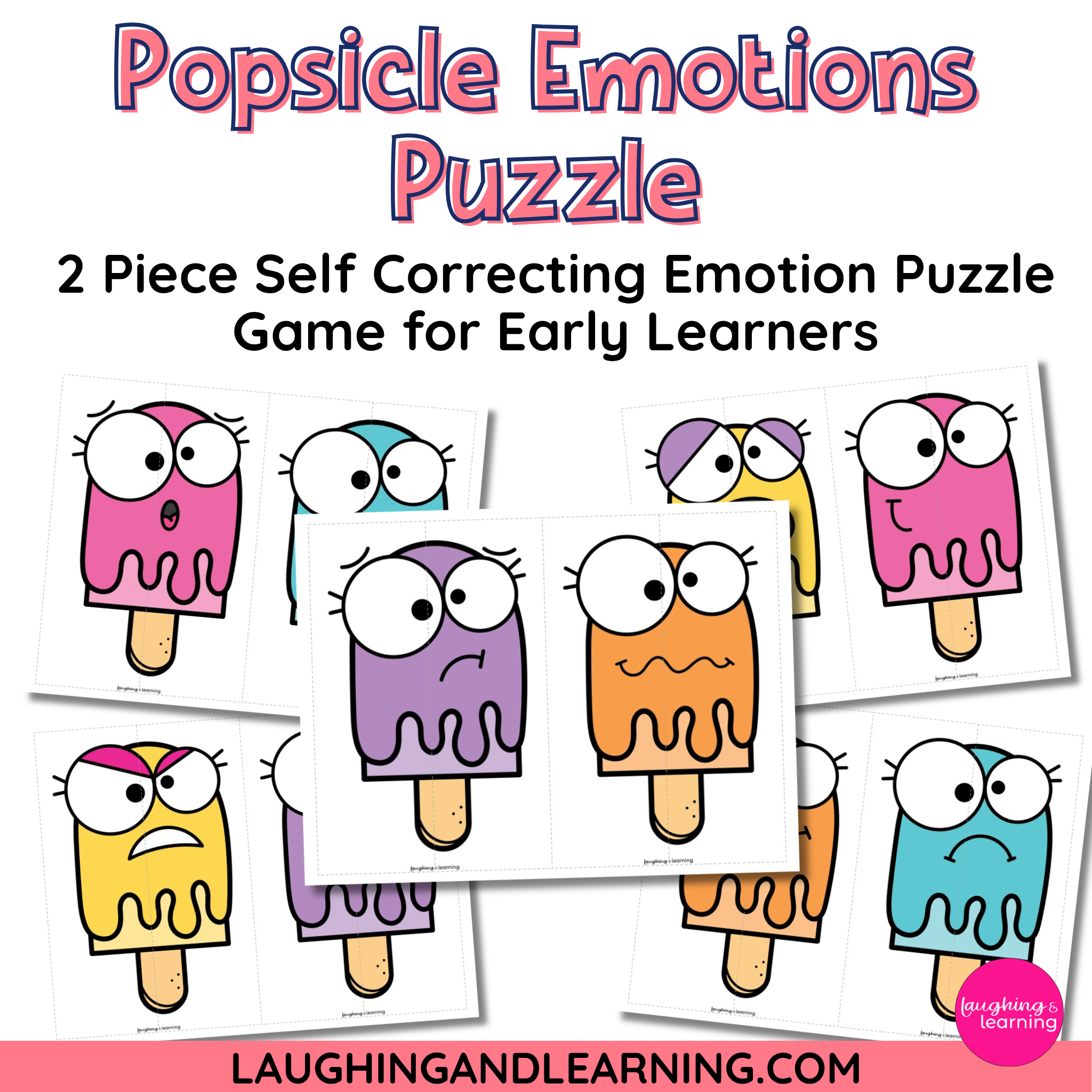
Learning to name a feeling is one of the most powerful things a young child can do. When children can identify what they are experiencing – and recognise those same emotions in others – they are better equipped to communicate, connect, and regulate themselves. The Popsicle Emotions Puzzle is a printable emotions activity for preschool that makes this essential skill feel like play. Ten self-correcting two-piece puzzles, each shaped like a colourful popsicle character, invite children to assemble expressive faces and name the feeling they see.
Designed for children ages 3–6, this resource is a natural fit for preschool and Pre-K social-emotional learning centres, kindergarten classrooms, and at-home emotional literacy routines. It is bright, engaging, and thoughtfully designed – the kind of activity that opens up real conversations about feelings without putting any child on the spot.
What Is the Popsicle Emotions Puzzle?
The Popsicle Emotions Puzzle is a set of ten self-correcting, two-piece puzzles. Each puzzle is shaped like a popsicle character and split vertically down the centre into a left half and a right half. Children assemble the left and right halves to complete a full facial expression on each popsicle character.

The self-correcting design is an important feature. The puzzle pieces are cut with unique edges, so each left half only fits correctly with its matching right half. Children can check their own work simply by looking at whether the face aligns – no adult intervention required. This builds independence, problem-solving confidence, and a sense of ownership over the learning.
The ten puzzles cover a wide and nuanced range of expressions:
- Happy
- Sad
- Angry
- Surprised
- Silly
- Worried
- Vampire grin
- Smirking
- And more
That variety matters. Many early childhood emotion resources focus only on the most basic feelings. This set goes further, introducing children to subtler emotional states that are harder to name but just as real to experience.
The resource includes:
- 10 self-correcting two-piece popsicle emotion puzzles
- A teacher guide with instructions, targeted skills, classroom centre ideas, extension activities, and differentiation strategies
Skills This Emotions Activity for Preschool Develops
The Popsicle Emotions Puzzle targets social-emotional development as its core domain, but its benefits reach across several areas of early childhood learning.
Social-Emotional Learning Children practise facial expression recognition, emotion vocabulary and labelling, empathy and perspective-taking, and self-regulation thinking. Teacher talk prompts encourage deeper reflection: “What helps you when you feel _?” These are not just puzzle questions – they are the kinds of questions that build emotional intelligence over a lifetime.
Language and Communication As children assemble and discuss each face, they naturally use descriptive language to articulate what they observe: “I see raised eyebrows” or “her mouth looks worried.” This kind of language practice strengthens vocabulary and supports the conversational turn-taking that is fundamental to communication development.
Cognitive and Executive Function The self-correcting format requires children to use visual discrimination to detect subtle differences between facial cues. When a piece does not fit, children must problem-solve and self-correct – a valuable executive function skill. Working memory is also engaged as children recall which halves they have already tried.
Fine Motor Development Picking up, aligning, and placing puzzle pieces develops pincer grip, bilateral coordination, and hand-eye coordination. These are the same fine motor skills that support writing readiness and general dexterity.
How to Use This Activity in Your Classroom or Home

This emotions activity for preschool is versatile enough to work across several different instructional settings and daily routines.
Social-Emotional Learning Centre Place all puzzle pieces mixed together in a tray or basket. Children sort through the pieces, assemble their puzzles, and name each emotion as they complete it. The self-correcting design allows children to work independently, making this ideal for unsupervised centre time.
Small Group Instruction Work through a selection of puzzles together in a small group. Hold up each completed face and invite discussion: “Has anyone ever felt like this? What happened?” Small group time creates a safe, supportive space for children to practise emotional vocabulary with peers.
Morning Tub Activity Set out two or three puzzles in a bin during arrival time for a calm, engaging start to the day. Emotion-focused morning activities naturally set a reflective, connected tone for the session ahead.
Read-Aloud Extension After reading a picture book with a strong emotional theme, bring out the puzzle pieces and ask children to find the face that matches how a character was feeling. This bridges literacy and social-emotional learning in a meaningful way.
Extensions to Deepen the Learning

Three optional extensions are built into this resource, and each one adds a meaningful layer without requiring any additional materials.
Positive and Uncomfortable Feelings Sort – After completing the puzzles, children sort the finished faces into two groups: feelings that feel comfortable (happy, silly) and feelings that feel uncomfortable (worried, angry, sad). This builds emotional categorisation skills and opens up conversation about the full range of human emotional experience.
Mirror Practice – Provide a small mirror and invite children to make the same facial expression as their completed popsicle. This embodied learning approach strengthens the connection between the visual image and the physical sensation of an emotion – a powerful tool for developing empathy and self-awareness.
Word Card Match – Add printed emotion word cards to the activity and ask children to place the matching word beside each completed puzzle. This extension creates a natural bridge between social-emotional learning and early literacy, reinforcing both emotion vocabulary and word recognition simultaneously.
Differentiation for Every Learner
Children develop emotional literacy at different rates, and this resource makes it easy to meet each child where they are.
Beginning Learners – Start with the most recognisable expressions: happy, sad, and angry. Offer two pieces at a time – one left half and one right half – so children are not overwhelmed by sorting through the full set. Name the emotion together before and after assembling each puzzle.
Developing Learners – Introduce the full set of ten puzzles in a mixed pile and let children sort and assemble independently. Encourage them to name each emotion as they complete it and use the teacher talk prompts to spark a short conversation about when they have felt that way.
Advanced Learners – After assembling and naming, ask children to describe what they notice about the facial features: “What tells you this popsicle is surprised? What do you see?” This metacognitive layer – thinking about how we read emotions – builds sophisticated emotional intelligence and descriptive language skills.
Preparation Tips

Getting this resource ready takes only a few steps.
- Print all puzzle pages on cardstock for durability.
- Laminate each page for long-term, wipe-clean use.
- Cut along the outer dashed rectangles to separate each puzzle card.
- Slice down the dotted centre line to divide each puzzle into its two halves.
- Store all pieces in a small bin or ziplock bag, mixed together for sorting practice.
Once laminated, these puzzles will hold up beautifully through months of repeated daily use. The self-correcting design also means children can reset and redo them independently – no teacher setup required between rounds.
Why This Emotions Activity for Preschool Works
Young children are not born knowing the names for what they feel. That vocabulary has to be built – word by word, experience by experience, and conversation by conversation. The Popsicle Emotions Puzzle creates the conditions for those conversations to happen naturally.

The popsicle characters are expressive without being overwhelming. Their exaggerated eyes, eyebrows, and mouths make each emotion clearly readable, even for children who are just beginning to learn emotional vocabulary. The puzzle format adds a layer of engaging challenge that keeps children focused on the task. And the self-correcting design means every child can experience the satisfaction of getting it right – independently.
For educators, this resource integrates seamlessly into SEL routines without requiring scripted lessons or lengthy preparation. For parents, it offers a playful, structured way to talk about feelings at home. And for children, assembling a surprised or silly popsicle face and naming what they see is simply a joyful, meaningful experience.
Emotional literacy is not a soft skill. It is a foundational one. This resource helps build it in a way that young children can access, enjoy, and return to again and again.
Download the Popsicle Emotions Puzzle

Ready to bring this emotions activity for preschool into your learning space? The Popsicle Emotions Puzzle is available as a digital download from Laughing and Learning. Print, laminate, and watch your little learners put their feelings together – one popsicle at a time.
Looking for More Summer Themed Activities?
If your learners loved these Popsicle Emotions Puzzles, you’ll find even more resources in the Laughing & Learning shop! From printable worksheets to hands-on literacy and math activities, there’s something for every learner.
If you use this in your classroom or at home, I’d love to hear how it went! Drop a comment below or tag me on Instagram. 🌸