
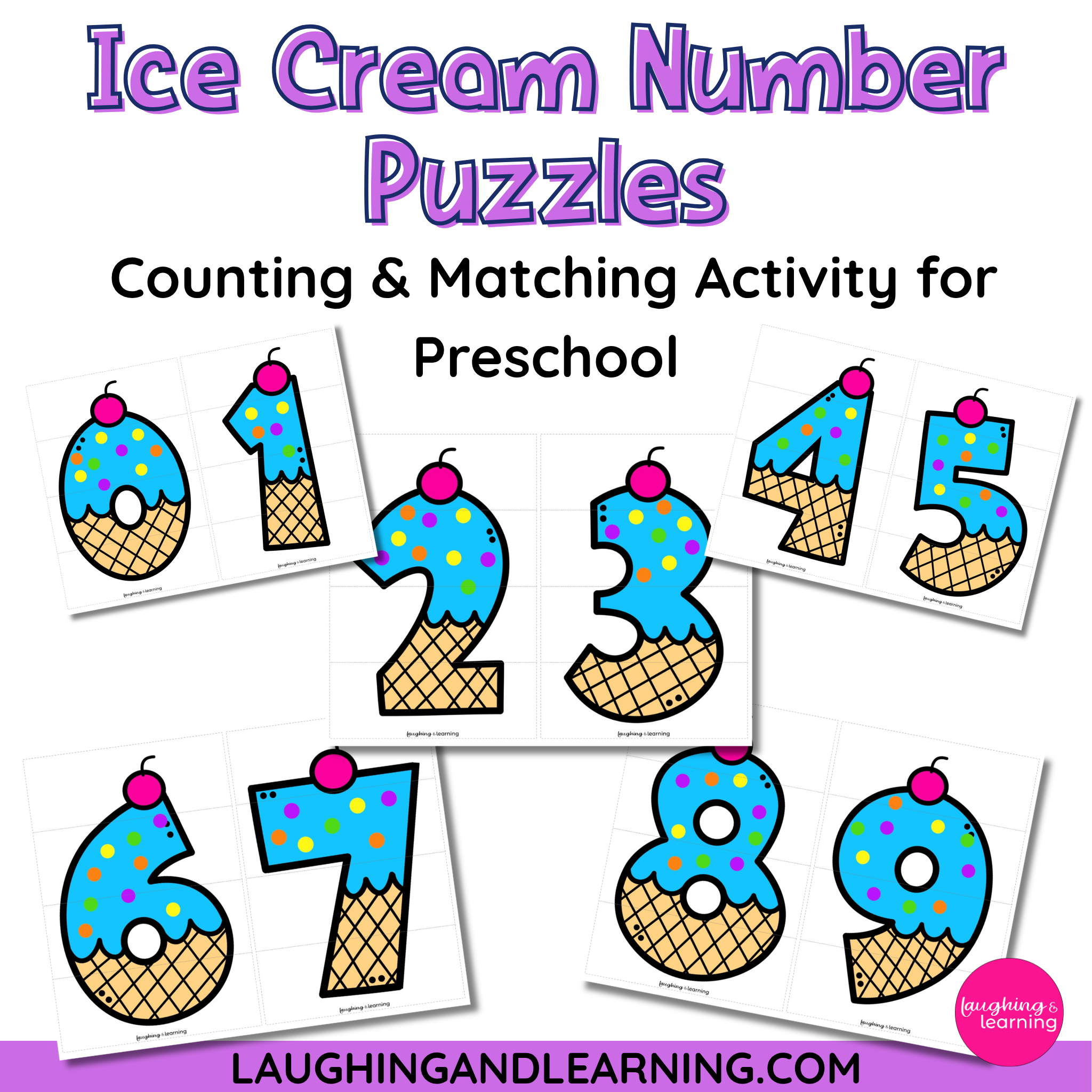
There is something almost magical about a resource that makes children want to do math. The Ice Cream Number Puzzles are exactly that kind of resource. Bright, bold ice cream cone numerals – dripping with blue frosting, dotted with colourful sprinkles, and topped with a cheerful cherry – turn the foundational work of number recognition and counting into something children genuinely look forward to. This printable number puzzle activity for preschool covers numerals 0–9 through ten self-correcting two-piece puzzles that are as satisfying to assemble as they are effective for building early math skills.
Designed for children ages 3–6, this resource is a natural fit for preschool and Pre-K math centres, kindergarten classrooms, summer-themed learning units, and at-home math routines. Whether children are just beginning to recognise numerals or are ready to practise ordering and composing numbers, this activity meets them where they are.
What Are the Ice Cream Number Puzzles?
The Ice Cream Number Puzzles are a set of ten self-correcting, two-piece puzzles. Each puzzle is shaped like a numeral – styled as an ice cream cone, with a waffle cone base and a blue frosted scoop on top – and split into two halves along cut lines. Children hunt for the matching half and join the two pieces to build the complete ice cream number.
The self-correcting design is one of the resource’s most valuable features. Each puzzle pair has a unique cut so that the two halves only fit together correctly when matched. Children can check their own work simply by looking at whether the numeral aligns – no adult input needed. This independence builds confidence, problem-solving persistence, and a genuine sense of mathematical agency.

The puzzles can be cut along the guidelines to create either two-piece or four-piece puzzles, giving educators immediate built-in differentiation. An optional self-check dot can also be added to the back of each correct pair for additional support.
The resource includes:
- 10 self-correcting ice cream number puzzles (0–9)
- Clear cut lines for two-piece or four-piece options
- A comprehensive teacher guide covering four core activities, five variations and extensions, and full differentiation strategies
Four Core Activities Built Into the Resource

What elevates this number puzzle activity for preschool beyond a standard matching game is the four structured engagement modes built directly into the resource. Each one targets a different mathematical skill – and each one uses the same ten puzzles.
Core Match: Build the Numeral Lay one side of all puzzles face up. Children hunt for the matching other half and join the two pieces to build the complete ice cream number. After each match, read it together: “That makes the number 6!” This foundational task builds numeral recognition through active searching and physical assembly.
Find and Build After each match, the child says the number aloud and represents the quantity using counters. This task is a critical bridge between numeral recognition and quantity understanding – two skills that must develop together for true number sense to form.
Race to Five Partners take turns assembling puzzles. The first to complete five wins, then both trade sets and play again. This competitive, game-like format adds energy and motivation while keeping the numeral-building practice at the centre of the experience.
Order and Show Arrange finished puzzles in numerical order from smallest to largest. Then model each number with counters beneath the matching puzzle. This extension connects numeral recognition, sequencing, and cardinality in a single, hands-on task that offers real mathematical richness.
Skills This Number Puzzle Activity for Preschool Builds
The Ice Cream Number Puzzles are rooted in early math, but they develop skills across several important domains.

Early Math Foundations Children build numeral recognition, one-to-one counting correspondence, and cardinality – the understanding that the last number counted represents the total quantity. They also practise comparing numbers (more/fewer), ordering from least to most, and early composing and decomposing toward targets. These are the precise skills that predict later mathematical success.
Language and Communication Math talk is woven into the activity throughout. Children explain their matching choices (“same curve/shape”), use comparative number words accurately, and articulate their mathematical thinking in age-appropriate language. This kind of talk develops number vocabulary alongside conceptual understanding.
Cognitive and Executive Function Visual discrimination of the two halves, problem-solving during assembly, self-correction when pieces do not align, working memory while searching for partners, and sustained attention through the full set – all of these executive function skills are exercised repeatedly and naturally within the puzzle format.
Fine Motor Development Handling, aligning, and joining puzzle pieces builds pincer grasp, bilateral coordination, and hand-eye precision for clean joins. These fine motor skills support writing readiness and general dexterity alongside the mathematical learning.
Positive Learning Behaviours Following multi-step directions, cooperating during partner activities, and experiencing the confidence of successful completion all develop through repeated engagement with this resource. These habits of mind – persistence, cooperation, self-efficacy – are as important as the math itself.
Variations and Extensions to Deepen the Learning

Five built-in extensions give this resource exceptional staying power across a full school year.
More / Less – Pick two completed numbers and decide which is more or less, explaining why. This comparative thinking is a foundational early math skill that develops alongside numeral recognition rather than after it.
Number Line Check – Place matched puzzles in a row and spot missing numbers. “We have 3, 4, and 6 – which number is missing?” This sequencing task builds number line awareness and gap-spotting skills.
Compose / Decompose – Use two completed numbers to make 10 (or another target) and say the fact aloud: “6 + 4 = 10.” This extension introduces early addition concepts in a concrete, low-pressure format.
Recording Sheet (DIY) – After assembling a puzzle, the child draws the ice cream numeral and writes it on a recording sheet. This bridges the hands-on puzzle work with early mark-making and numeral writing.
Memory Mix – Turn one set of halves face down and flip two at a time to find the matching partner. This memory game format builds working memory and numeral recognition fluency while keeping the activity feeling fresh.
Differentiation for Every Learner
This resource is designed to flex across a wide range of mathematical development levels.
Narrow the Field – Offer just 2–3 puzzles at a time, adding more as confidence grows. Starting with the most familiar numerals – those in a child’s name, age, or classroom number – creates immediate personal connection and reduces overwhelm.
Visual Scaffolds – Keep a number line visible as a reference tool. This support fades naturally over time as children internalise numeral recognition. For the Order and Show activity, a number line also provides a meaningful self-check.
Challenge – Mix non-consecutive ranges (3, 5, 6, 9) or add time trials for the ordering task. Advanced learners can also be asked to arrange their completed puzzles in reverse order – a simple variation that adds genuine cognitive challenge.
Support – Provide counters so learners can physically check their reading of each numeral by counting out the matching quantity. This concrete support is especially valuable for children who are still developing the symbol-to-quantity connection.
Preparation Tips
Getting this resource ready is straightforward and quick.
- Print all puzzle pages on cardstock for durability.
- Laminate each page for long-term, wipe-clean use.
- Cut along the guidelines to create two-piece puzzles – or cut further to create four-piece versions for added challenge.
- Optionally, add a small self-check dot to the back of each correct pair.
- Store pieces in a small bin or labelled ziplock bag for easy access.
Once laminated, these puzzles hold up through an entire school year of daily use. The choice of two-piece or four-piece formats means the same set of cards provides built-in challenge progression without requiring additional materials.
Why This Number Puzzle Activity for Preschool Works

Number recognition alone is not number sense. Children also need to count, compare, sequence, and connect numerals to quantities – and they need to do all of this repeatedly, in varied contexts, before those concepts become truly secure. The Ice Cream Number Puzzles create the conditions for that kind of rich, repeated practice.
The ice cream theme does something important: it makes the activity feel like a treat. Children who are excited to pick up a puzzle are children who will engage more deeply, persist longer, and return more willingly. The self-correcting format ensures that every child – regardless of starting point – can experience the satisfaction of getting it right on their own. And the five extension activities mean the same set of puzzles continues to offer meaningful challenge as children’s skills grow.
For educators, this resource integrates cleanly into existing math centre rotations without requiring additional planning or preparation. For parents, it is a print-and-play activity that turns kitchen table math into something children request. And for children, building a frosted, sprinkle-covered 7 or 9 out of two puzzle pieces is simply a wonderful way to start learning numbers.
Get the Ice Cream Number Puzzles

Ready to bring this number puzzle activity for preschool into your learning space? The Ice Cream Number Puzzles are available as a digital download from Laughing and Learning. Print, laminate, and watch your little learners scoop up number skills – one ice cream numeral at a time.
Looking for More Summer Themed Activities?
If your learners enjoy these Ice Cream Number Puzzles, you will find many more hands-on resources in the Laughing & Learning shop. Happy learning!
If you use this in your classroom or at home, I’d love to hear how it went! Drop a comment below or tag me on Instagram. 🌸