
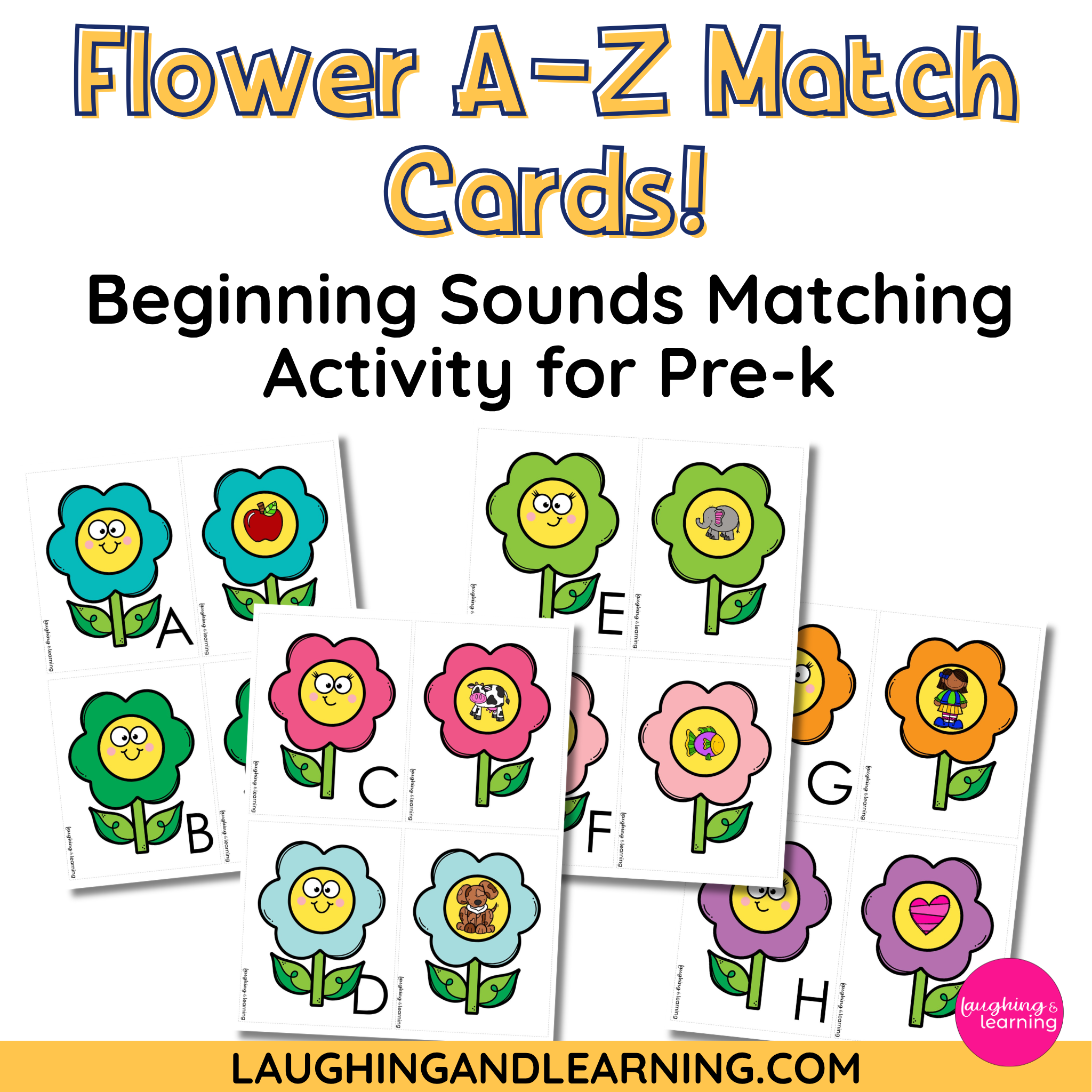
Teaching beginning sounds does not have to be dry or repetitive. These flower beginning sounds match cards for preschool bring phonics to life through a beautiful, nature-inspired design. Children match picture petal cards to the correct flower centre – connecting initial sounds to letters in a hands-on, engaging way. It is the kind of activity that feels like play but builds real early literacy skills.
Whether you use it in spring, summer, or any time of year, this resource fits naturally into a preschool or kindergarten literacy block.
What Are Flower Beginning Sounds Match Cards?

This is a printable phonics matching activity. Each letter of the alphabet (A–Z) has a corresponding flower centre card. The flower centre shows the uppercase letter in the middle. A separate picture petal card features a common object that starts with that letter’s sound.
Children’s task is simple: match each picture petal to the flower centre that shares its beginning sound. To do this, they must listen carefully to the initial sound of the word and connect it to the correct letter.
The flower design is intentional. Each letter centre has a distinct colour and cheerful face. The picture petals are sized to sit beside the centres naturally. Together, they create a matching pair that is visually satisfying and literacy-rich.
What’s Included in This Set
This resource is ready to print and easy to prepare. Here is everything included:
- A–Z flower centres – uppercase letters displayed on the flower’s centre
- Picture petal cards – common objects matched to each letter by initial sound
- Cutting guides – outer dashed rectangle for trimming petals and centres apart
- Detailed teacher instruction pages – with engagement ideas, extension activities, and differentiation strategies
The cutting guide design is a practical touch. All cards trim to a uniform size. That makes sorting, storing, and setting up the centre fast and straightforward.
Skills This Activity Builds

These flower beginning sounds match cards target a wide range of early literacy and developmental skills. They go well beyond simple letter recognition.
Phonemic Awareness – Children must isolate the initial sound in each picture word. That is a foundational phonemic awareness skill. Hearing and identifying the first sound in a word is one of the strongest predictors of early reading success. This activity gives children repeated practice with that exact skill.
Letter-Sound Correspondence – Matching a picture to a letter connects sound to symbol. This is letter-sound correspondence – a core component of early literacy. Children who develop strong letter-sound correspondence move into decoding with much greater confidence.
Vocabulary Expansion – Each picture petal introduces a common object. Some words, like igloo or kite, may be new to some children. Naming and discussing those pictures naturally expands vocabulary alongside phonics skills.
Language and Communication – This activity encourages descriptive talk. Teacher prompts like “I hear /m/ in moon” model clear articulation of beginning sounds. Children soon begin to use that same language independently. Turn-taking during partner activities also builds conversational skills.
Cognitive and Executive Function – Matching tasks require sorting and categorizing. Children must hold a sound in mind, scan the available centres, and make a decision. That process strengthens visual discrimination, working memory, and sustained attention – all executive function skills that support learning across every subject.
Fine Motor Development – Handling individual petal cards builds pincer grasp. Bilateral coordination develops as children hold the centre steady with one hand and place the petal with the other. An optional clothespin variation further strengthens hand muscles – a bonus for children preparing for writing.
Early Math Integration – Counting the petals placed on each flower introduces early numeracy. Comparing how many petals two flowers have builds vocabulary like more and fewer. These are small moments, but they add up.
How to Use Flower Beginning Sounds Match Cards in the Classroom
This resource works in multiple settings. It suits independent literacy centres, small group instruction, and whole-class warm-ups equally well.

Basic Match-and-Name – Set up a few letter centres at a time – start with three to six letters. Scatter their picture petals nearby. Children pick up a petal, say the word, isolate the first sound, and match it to the correct flower. Have them say the word, the sound, and the letter name aloud as they place each petal.
Sort and Classify – Mix petals from multiple letters together. Children sort them into the correct flower centres. This version works well for review and reinforces sorting skills at the same time.
Challenge Mode – Add a few distractor petals to the pile – images whose beginning sounds do not match any of the displayed centres. Children must decide which petals belong and which do not. This sharpens discrimination skills considerably.
Fine Motor Boost: Clothespin Version – Instead of placing petals beside the centre, children clip them around the edge using a clothespin. This mimics the appearance of a real flower and adds a powerful fine motor component to the activity.
Sensory Bin Extension – Hide picture petals in a rice or bean sensory bin. Children dig them out, identify the beginning sound, and match them to letter mats. This version is highly engaging for sensory-seeking learners.
Recording Sheet (DIY) – Children choose a letter, draw one object that starts with that sound, and label it. This extension bridges the matching activity to early writing in a natural, low-pressure way.
Differentiation Strategies

This resource meets a wide range of learners within the preschool and kindergarten age group.
For learners who need support: Begin with just three to six high-frequency letters – M, S, T, A, P, N are strong starting points. Keep the matching set small. Use only one petal per centre to start. Provide verbal prompts and model the language: “I hear /s/ at the start of sun. Which letter makes /s/?”
For learners ready for a challenge: Introduce all 26 centres at once. Add distractor petals with similar-sounding words (e.g., fox and fan both in the mix for F). Encourage children to sort multiple petals per letter, building a fuller flower shape as they work.
Colour-coding the back of each matching pair also allows children to self-check independently. One small dot per pair – same colour on the centre and its petal – removes the need for constant teacher confirmation.
Preparation Tips
Print on cardstock for durability. Laminate for long-term, wipe-clean use. Cut each page first along the outer dashed rectangle. Then separate flower centres from picture petals. Do not cut the solid lines – those keep each card intact.
Store centres and petals in separate labelled bags. You can pull out exactly the letters you need for any given day. That flexibility is especially useful during differentiated instruction.
Why a Flower Theme Works Year-Round

Spring and summer are the obvious seasons for a flower theme. But this resource works well any time of year. The bright, cheerful illustrations keep children engaged. The familiar shape of a flower makes the matching mechanic instantly intuitive – even for children new to literacy centres.
The multicultural picture illustrations also ensure that every child can see themselves reflected in the activity. Representation in early learning materials matters – and this set delivers it thoughtfully.
Recommended Age and Setting
This activity is ideal for ages 3–6. It is designed for Preschool, Pre-K, and Kindergarten literacy centres. It also works well as a pocket chart set, a small group activity, or an independent bin during centre rotations.
The built-in differentiation makes it suitable for a wide ability range within that age group. From children just beginning to recognize letters to those ready for initial sound isolation – this one resource supports them all.
Final Thoughts
Flower beginning sounds match cards for preschool give teachers a flexible, low-prep phonics tool that children genuinely enjoy. The visual appeal of the flower design draws children in. The phonemic awareness work keeps them growing. With A–Z coverage, multiple extension options, and built-in differentiation, this resource earns its place in any early literacy classroom.

If you are looking for a spring or summer phonics activity that is as beautiful as it is educational, this is it.
Looking for More Spring Activities?
If your learners enjoy this Beginning Sounds Flower Match, you will find many more hands-on resources in the Laughing & Learning shop. Happy learning!
If you use this in your classroom or at home, I’d love to hear how it went! Drop a comment below or tag me on Instagram. 🌸