
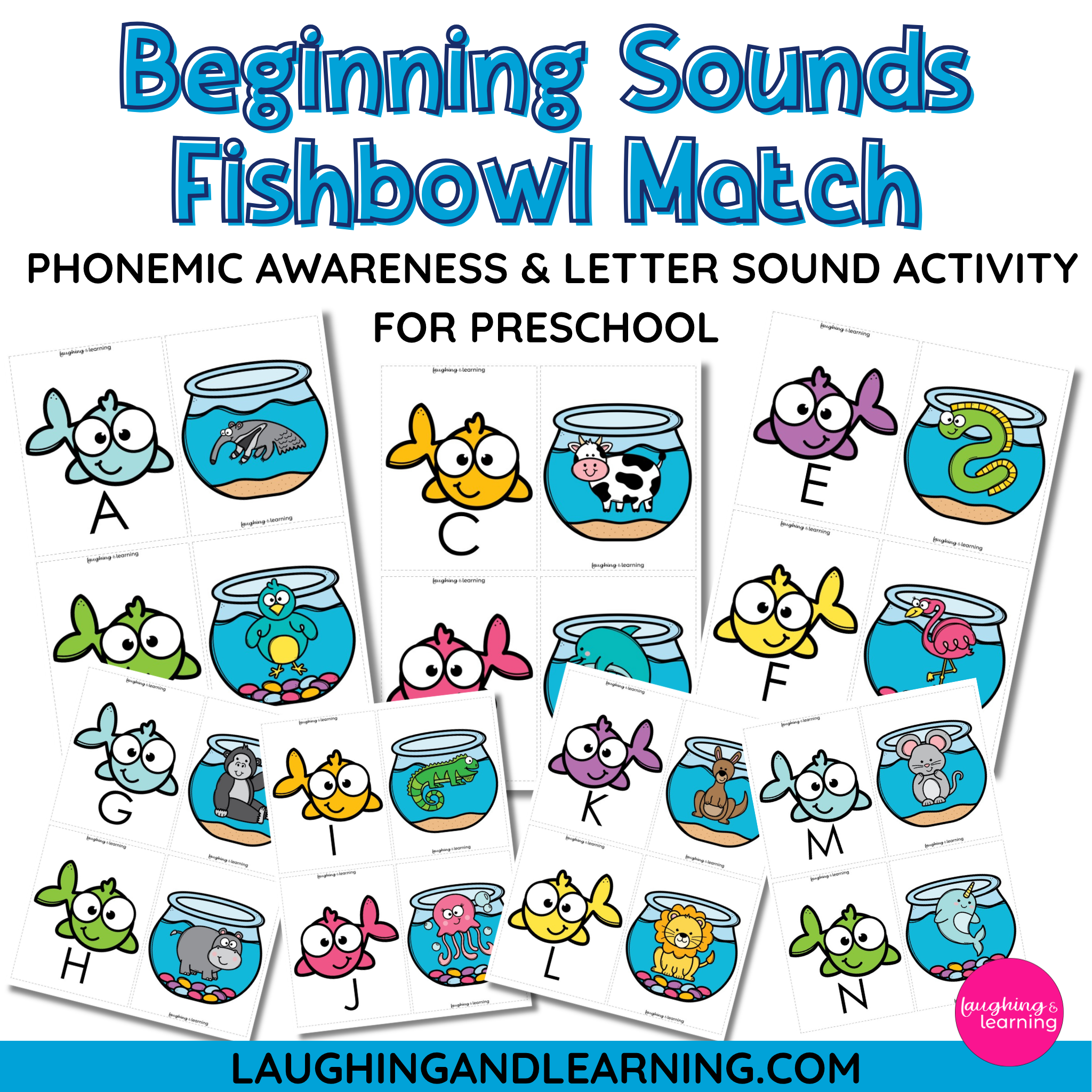
Strong phonics instruction begins with one foundational skill: the ability to hear the first sound in a word and connect it to a letter. When children can do this fluently and automatically, the door to reading opens. The Beginning Sounds Fishbowl Match is a printable beginning sounds activity for kindergarten that makes this critical skill feel like an adventure – matching colourful fish letter cards to fishbowl picture cards filled with animals whose names start with the corresponding initial sound.
Twenty-six fish characters, each displaying an uppercase letter, swim alongside twenty-six fishbowls, each containing a vividly illustrated animal whose name begins with that letter’s sound. Children look at the picture, isolate the initial sound, and find the fish that matches. The result is a hands-on, multi-mode phonics resource that works beautifully from the first week of school through to the end of the year.
Designed for children ages 3–6, this resource is ideal for preschool, Pre-K, and kindergarten literacy centres, pocket chart activities, small group rotations, and at-home phonics practice.
What Is the Beginning Sounds Fishbowl Match?

Also titled the Alphabet Aquarium: Fishbowl Match, this resource is a two-part card set covering the full alphabet A–Z. Each letter has one fish card displaying the uppercase letter and one fishbowl card featuring a picture of an animal whose name begins with that initial sound.
The animal images are vivid, clear, and carefully chosen – a bat for B, a cow for C, a dolphin for D, a gorilla for G, a kangaroo for K, a raccoon for R, a sloth for S, a yak for Y, a zebra for Z, and more across the full set. The consistent card design means children can focus entirely on the sound-symbol connection rather than navigating different formats.
The resource includes:
- 26 uppercase fish letter cards (A–Z)
- 26 fishbowl picture cards featuring animals with matching initial sounds
- Cutting guides for uniform card size
- A comprehensive teacher guide covering five core activities, five variations and extensions, and full differentiation strategies
Four Core Activities Built Into This Beginning Sounds Activity for Kindergarten

What distinguishes this resource from a basic matching set is the four structured engagement modes built into the teacher guide. Each one targets a different aspect of phonemic awareness and letter-sound correspondence – and each one uses the same set of cards.
Core Match: Letter to Beginning Sound Lay picture cards face up in a group of 5–12 at a time. The child names a picture, isolates the first sound, and matches the correct fish letter card. Say it together: “/s/ – sloth – S.” This foundational task builds the automatic sound-isolation habit that underlies all phonics learning.
Pocket Chart Centre (Fishbowl Wall) Load a row of picture cards in the pocket chart and provide a stack of letter cards. Children take turns placing the matching letter card under each picture. This shared, interactive format works well for whole-class warm-ups and small group instruction alike.
Scoot the Room Tape picture cards around the classroom and have children move from card to card, finding the matching letter and writing the first letter on a recording sheet. This active, movement-based format is especially valuable for kinaesthetic learners who engage most deeply when their whole body is involved in the task.
Recording Sheet (DIY) Children find each picture, say the first sound, and write the matching letter on a simple recording sheet. This writing extension bridges phonics with early mark-making – a natural step toward spelling readiness.
Skills This Activity Builds
The Beginning Sounds Fishbowl Match develops a rich cluster of early literacy and cognitive skills through every activity mode.

Early Literacy and Phonics Children isolate initial sounds in spoken words, build letter-sound correspondence across the full alphabet, strengthen letter recognition, and expand vocabulary as they encounter and name each animal picture. These are precisely the phonemic awareness and phonics skills that reading research identifies as the strongest predictors of early reading success.
Language and Communication Every match is an opportunity for language: clear articulation of sounds, descriptive talk about pictures, and conversational turn-taking during partner and group activities. Teacher talk prompts keep these conversations purposeful: “What do you hear first in ___? Say it slowly.” / “What other words start with that same sound?”
Cognitive and Executive Function Sorting and classifying pictures by initial sound, auditory discrimination between similar sounds, working memory while searching for the correct letter, and self-correction when a match does not sound right – all of these executive function skills develop through repeated, purposeful engagement with the cards.
Fine Motor Development Handling, sorting, and placing cards builds pincer grasp and hand-eye coordination. The write-it station and recording sheet extension add pencil-control practice to the fine motor benefits.
Positive Learning Behaviours Persisting with distractor sounds, building confidence through accurate matching, and following multi-step directions during the rotation and scoot activities all support the learning habits that matter across every subject area.
Variations and Extensions to Deepen Phonics Learning

Five built-in extensions give this resource exceptional range and staying power.
Sound Sort – Put 3–4 letter headers in a pocket chart (for example S, M, T, A). Children sort picture cards by initial sound into the correct column. This categorisation task deepens phonemic awareness and builds the auditory discrimination skills needed for reading and spelling.
Upper vs. Lower – Use lowercase letter cards for sound-focused rounds, or mix uppercase and lowercase together for the added challenge of finding the partner across cases. This variation connects phonics practice to letter recognition work.
Distractors – Add 1–2 non-matching letter cards to the set before play. Children must listen carefully and reject incorrect options – a higher-order phonics task that builds auditory precision and self-monitoring skills.
Tricky Pairs Coaching – Briefly teach the commonly confused sound pairs: c/k, g/j, x (as /ks/), and q (with u). These are the sounds that trip up even confident early readers, and dedicated coaching with picture support makes the distinctions stick.
Name Link – Invite children to find the first letter of their name among the picture set and connect it to the animal whose name begins with the same sound. This personal connection is one of the most powerful hooks in early phonics instruction.
Differentiation for Every Learner
This resource adapts cleanly to a wide range of phonics development levels.
Narrow the Field – Start with 6–8 letters featuring frequent, distinct sounds (m, s, t, a, p, n). Add more as confidence and accuracy grow. Beginning learners are never overwhelmed by the full alphabet before they are ready for it.
Visual Supports – Keep a sound wall nearby with mouth pictures and keywords for each sound. This reference tool supports children who are still building phoneme-grapheme connections, and it fades naturally as sounds become automatic.
Confusables – Provide extra practice with the most commonly confused letter-sound pairs: b/d, p/q, m/n, u/v. Use finger-tracing and sky/grass/ground cues to help children build reliable auditory and visual memory for these tricky sounds.
For advanced learners, the Sound Sort and Tricky Pairs variations provide genuine challenge. Asking children to generate additional words that begin with each sound – beyond the picture card – extends phonemic awareness into the broader vocabulary they are building every day.
Preparation Tips
Getting this resource ready takes just a few minutes.
- Print all card pages on cardstock for durability.
- Laminate each page for long-term, wipe-clean use.
- Cut along the outer guidelines to create uniform card size.
- Store fish letter cards and fishbowl picture cards in separate small bins or ziplock bags for easy sorting during setup.
- Optional: use mini trays or baskets to display cards during centre time.
Once laminated, these cards hold up through a full school year of daily use across all five activity modes – a genuinely cost-effective phonics resource.
Why This Beginning Sounds Activity for Kindergarten Works

Phonemic awareness does not develop by accident. It develops through repeated, purposeful exposure to the sounds of language – and through activities that make that exposure feel meaningful rather than mechanical. The Beginning Sounds Fishbowl Match creates exactly the right conditions.
The fishbowl theme is distinctive and visually engaging. The animal pictures are clear enough to name instantly, which keeps children’s attention on the sound rather than puzzling over the image. The five activity modes ensure the same set of cards remains purposeful across weeks and months of practice. And the differentiation strategies mean every child – from the child who knows a handful of letter sounds to the child who is ready to sort by multiple sounds simultaneously – has a genuinely appropriate way to engage.
For educators, this resource integrates cleanly into existing phonics routines without additional planning. It works equally well as a whole-class activity, a small group rotation, a literacy centre, and a scoot game. For parents, it is a print-and-play phonics resource that opens up rich sound conversations at home. And for children, finding the fish that goes with a sloth or a zebra or a yak is simply a wonderful way to learn the sounds of the alphabet.
Get the Beginning Sounds Fishbowl Match

Ready to bring this beginning sounds activity for kindergarten into your learning space? The Beginning Sounds Fishbowl Match is available as a digital download from Laughing and Learning. Print, laminate, and watch your little learners dive deep into the sounds of the alphabet – one fishbowl at a time.
Looking for More Literacy Activities?
If your learners enjoy this Beginning Sounds Fishbowl Match, you will find many more hands-on resources in the Laughing & Learning shop. Happy learning!
If you use this in your classroom or at home, I’d love to hear how it went! Drop a comment below or tag me on Instagram. 🌸