
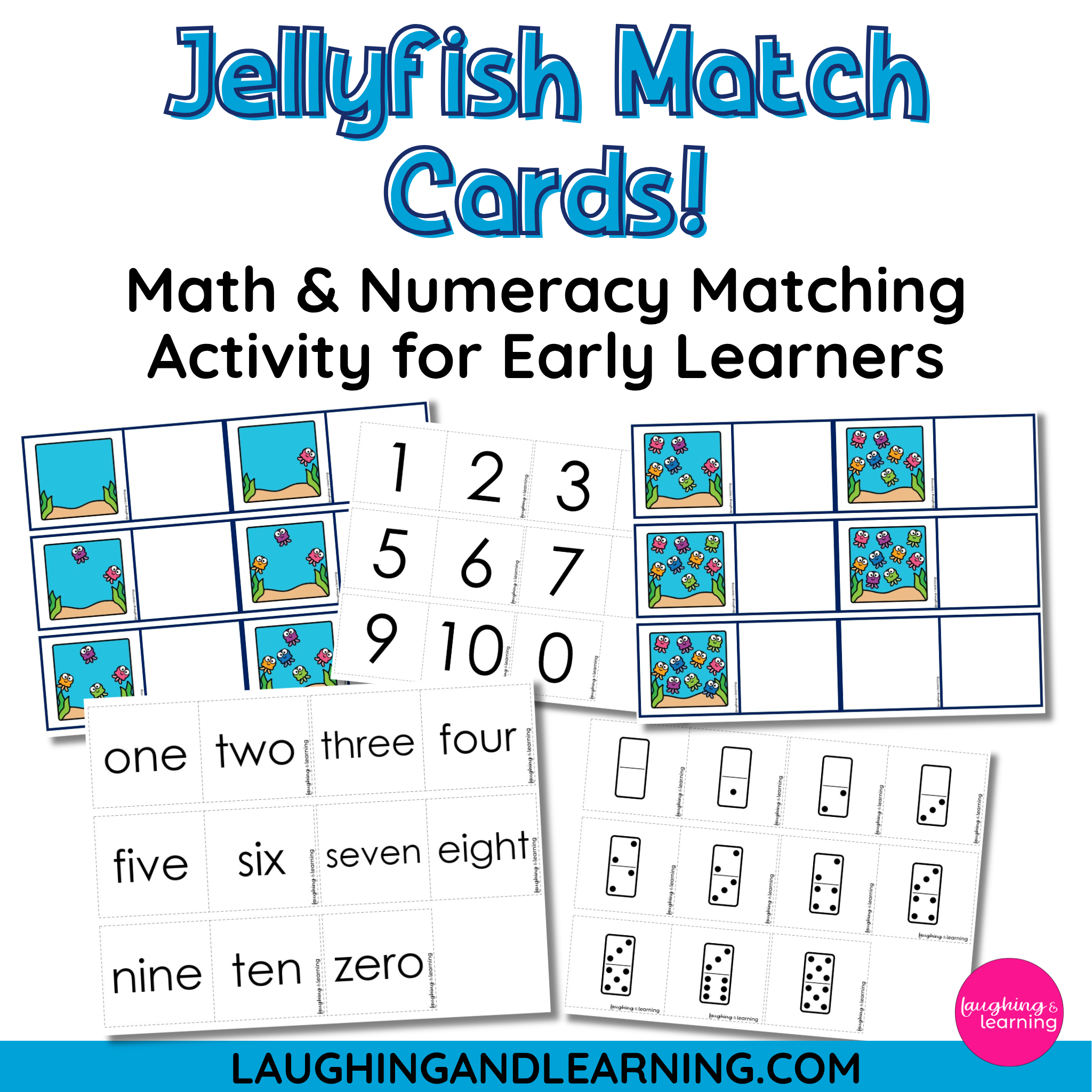
Number sense does not develop from worksheets alone. Children need hands-on experiences that connect the same number in multiple ways. These jellyfish number match cards for preschool do exactly that. They present numbers 0–10 through four different representations: numerals, number words, tally marks, and dominoes. Each format deepens a child’s understanding in a meaningful, lasting way.
Whether you need a low-prep math centre or a small group activity, this resource delivers.
What Makes This Resource Different

Most number matching activities use only two card types – a picture and a numeral. This set goes further. Children encounter the same quantity represented four different ways. That variety matters. Research consistently shows that children who connect multiple number representations develop stronger, more flexible math thinking.
The ocean theme adds immediate visual appeal. Bright jellyfish illustrations make the picture cards engaging. Children are drawn in before the learning even begins.
What’s Included in This Set

This resource includes four coordinated quantity card sets covering numbers 0–10. Here is everything inside:
- Numeral cards (0–10) – large, clear printed digits
- Number word cards (zero–ten) – for literacy integration
- Tally mark cards (0–10) – introducing a key math tool
- Domino cards (0–10) – supporting subitizing and dot recognition
- Picture cards – jellyfish groups showing corresponding quantities
- Cutting guides – trimmed to a uniform card size for easy mixing and sorting
The uniform card size is a practical detail that makes a real difference. All four sets line up neatly together. That consistency makes sorting, stacking, and organizing the centre much simpler.
Skills This Activity Builds
These jellyfish number match cards target a wide range of developmental skills. That makes them an efficient addition to any early learning program.

Early Math Foundations – Children practice counting with one-to-one correspondence. They develop cardinality – understanding that the last number counted tells how many. Subitizing is also embedded in the domino and picture cards. Children learn to recognize quantities instantly, without counting each item. They also work on numeral recognition, number word mapping, ordering, and comparing (more, fewer, one more, one less).
Cognitive and Executive Function – Matching across four card types requires visual discrimination. Children must look carefully and sort thoughtfully. Working memory and self-correction are both practiced throughout. The optional self-check dot on the back of each trio supports independent learning without constant teacher input.
Language and Communication – This activity naturally invites math talk. Children begin using vocabulary like zero, equal, fewer, and more. Teacher prompts included in the resource guide this language development: “How many do you see? How did you know?” These prompts gently introduce subitizing strategy conversations.
Fine Motor Development – Handling individual cards builds pincer grasp. Aligning trios neatly strengthens hand-eye coordination. These physical skills develop alongside the math – making this a genuinely whole-child activity.
Social-Emotional Learning – Partner and small group matching builds cooperation. Successfully completing a trio builds confidence. Both outcomes matter deeply in the preschool and kindergarten years.
How to Use Jellyfish Number Match Cards in the Classroom

This resource is designed for flexibility. There is no single right way to use it. Here are the most effective ways to set it up.
Core Match: Build-a-Trio – Lay out all picture cards face up. Children count the jellyfish and then place the matching quantity cards beside it. The goal is to build a complete set of three or four cards for each number. This is the most straightforward version and works well as an introduction.
Numeral to Picture Only (Beginners) – Start new learners with just two card types. Place numeral cards and picture cards on the table. Children match quantities to digits only. This reduces the cognitive load while still building core number recognition.
Word to Numeral Matching – Remove the picture cards. Children match number words to numerals. This adds a literacy link and works well as a stretch activity for confident counters.
Memory / Concentration – Mix any two sets of cards face down. Children take turns flipping pairs to find matches. This version is highly engaging and builds working memory alongside number sense.
Number Line – Arrange numeral cards in order from 0 to 10. Children then slide the matching picture cards under each numeral in sequence. This reinforces ordering and sequencing in a concrete, visual way.
Scoot / Move the Room – Tape picture cards around the classroom. Give each child a recording sheet. Children move around the room, count the jellyfish on each card, and write the matching numeral. This gets bodies moving – a strong choice for high-energy learners.
Missing Number – Place three cards in a sequence with one missing. Children supply the missing card from the remaining pile. This challenges children who are ready to think about number patterns.
Differentiation Strategies
This resource supports a full range of learners within the preschool and kindergarten age group.
For learners who need more support: Start with numbers 0–5. Add 6–10 as confidence grows. Provide counters to place on each jellyfish while counting. Colour-coding the card backs can also help (e.g., blue for numerals, green for words, purple for pictures). This gives children a visual scaffold for self-sorting.
For learners ready for a challenge: Add distractor cards – extra non-matching cards mixed into the pile. Ask extension questions after each match: “Show me one more. Show me one less.” Encourage grouping strategy talk: “Can you group to count faster – like 2, 3, 5?”
These adjustments do not require a separate activity. The same cards serve every learner in the room.
Preparation Tips
Getting this resource ready takes very little time. Print on cardstock for durability. Laminate for long-term, wipe-clean use. Cut along the outer guidelines – the uniform size means all card types mix together cleanly for sorting activities.
Sort the laminated cards into four mini-decks: numerals, number words, tallies, and dominoes. Store each deck in a small bag or tray section. This makes setup and pack-down fast and independent for children.
To set up the self-check system, place a small matching dot on the back of each correct trio. Children flip their completed sets to verify. It is a simple step that builds self-correction habits and reduces reliance on teacher confirmation.
Why Tally Marks and Dominoes Matter

Most preschool math resources stop at numerals and pictures. Including tally marks and dominoes sets this resource apart.
Tally marks introduce a real-world counting tool. Children begin to see that numbers can be recorded in different ways. This builds flexible thinking early. Dominoes support subitizing – the ability to recognize a quantity at a glance. Subitizing is a foundational skill. Children who subitize confidently move into addition and subtraction with much greater ease.
Including all four representations in one resource gives teachers a meaningful, efficient tool. One activity. Four mathematical connections. That is genuine value for a busy classroom.
Recommended Age and Setting
This activity is ideal for ages 3–6. It suits Preschool, Pre-K, and Kindergarten math and social-emotional learning centres. It also works well as a small group activity during guided math time.
The built-in differentiation means it fits a wide ability range. From beginners working on numeral recognition to confident counters exploring subitizing – this one resource covers the spread.
Final Thoughts
Jellyfish number match cards for preschool give children a rich, multi-layered look at numbers 0–10. Numerals, words, tally marks, and dominoes all work together in one cohesive, ocean-themed set. The result is a math centre that is low-prep for teachers and high-impact for learners.

If you want a resource that builds number sense in a meaningful, hands-on way, this is one worth having in your collection.
Looking for More Literacy Activities?
If your learners enjoy this Beginning Sounds Fishbowl Match, you will find many more hands-on resources in the Laughing & Learning shop. Happy learning!
If you use this in your classroom or at home, I’d love to hear how it went! Drop a comment below or tag me on Instagram. 🌸