
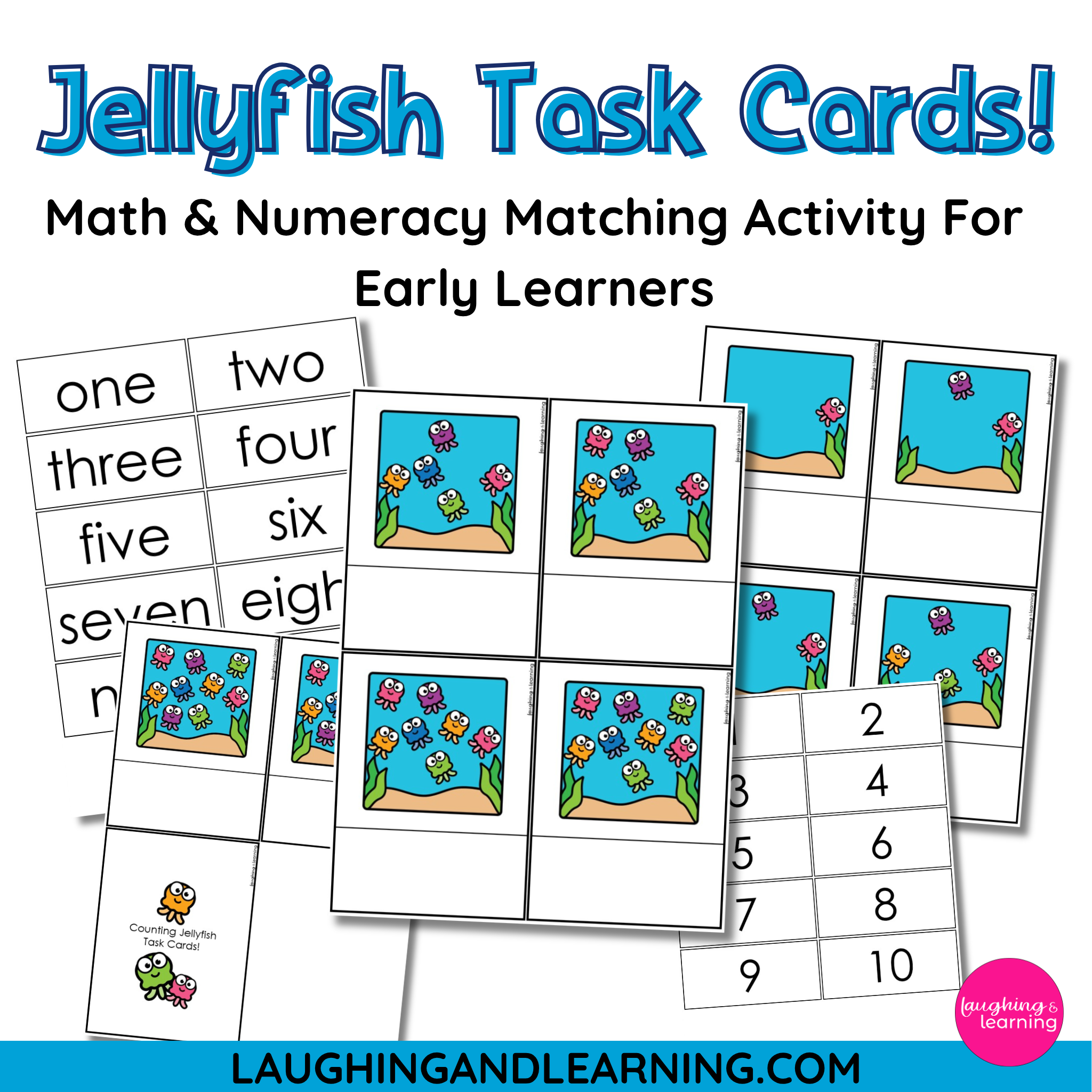
Getting young children excited about numbers takes the right activity. These jellyfish counting task cards for preschool make math feel like play. Children count colourful jellyfish, match numerals, and connect number words – all in one engaging, ocean-themed centre. Whether you are teaching in a preschool classroom or a kindergarten setting, this resource is flexible enough to fit right in.
What Are Jellyfish Counting Task Cards?

Counting task cards are simple, printable cards used in math centres. Each card features a picture, numeral, or number word. Children match the cards to build number sense and early math skills.
This set from Laughing & Learning focuses on numbers 1 to 10. It includes three types of cards that work together: counting picture cards showing groups of jellyfish, numeral cards (1–10), and number word cards (one–ten). Together, they give children multiple ways to connect the same number concept.
The ocean theme is engaging and easy for young children to relate to. The bright, cheerful jellyfish illustrations make counting feel exciting rather than routine.
What’s Included in This Set
This resource is packed with everything you need to run a smooth, independent math centre. Here is a full breakdown of what comes inside:

- 10 counting task cards (1–10) featuring groups of jellyfish to count
- 10 matching number-word cards (one–ten) for literacy integration
- 10 matching numeral cards (1–10) for number recognition
- An optional self-check system – add a small dot or sticker to the back of each matching trio
- Detailed teacher instruction pages with match-it options, centre variations, and differentiation strategies
The self-check feature is especially valuable. It allows children to confirm their own answers independently. This reduces teacher interruptions and builds confidence at the same time.
Skills This Activity Builds

These jellyfish counting task cards target a wide range of early learning skills. That is what makes them such a strong addition to any preschool or kindergarten math block.
Early Math Foundation – Children practice counting with one-to-one correspondence as they point to each jellyfish. They develop cardinality – understanding that the last number counted tells “how many.” They also work on numeral recognition 1–10, number word reading, comparing (more/fewer), and ordering from least to most.
Cognitive and Executive Function – Matching tasks require visual discrimination. Children must look carefully at each group and decide which number it represents. Working memory also comes into play as children track their count. The self-check system encourages self-correction, which is a key executive function skill.
Fine Motor Development – Handling the cards builds pincer grasp and hand strength. If you use clips or clothespins as part of the matching activity, children also practice hand-eye coordination and bilateral coordination.
Language and Communication – This activity naturally invites math talk. Children begin to use language like “I have more because…” or “this one has fewer.” Vocabulary words like equal, fewer, and more come up organically during the matching process.
Social-Emotional Learning
Social-Emotional Learning – When used in partner or small-group settings, children practice cooperation and turn-taking. Successfully completing a match builds real confidence – especially for children who find math challenging.
How to Use Jellyfish Counting Task Cards in the Classroom
One of the best things about this resource is how many ways you can use it. It works equally well as an independent centre, a small group activity, or a whole-class warm-up.

Numeral to Picture Matching – Place numeral cards (1–10) face up on the table. Children find the picture card that shows the matching quantity and place it beside the numeral. This is the most straightforward version and a great starting point.
Word to Picture Matching – Swap the numeral cards for number word cards. Children read the word and find the picture that matches. This adds a literacy component to the math activity.
Numeral to Word Matching – Remove the picture cards entirely. Children match numerals to their written words. This is a great challenge for learners who are ready to move beyond counting images.
Number Line Center – Arrange numeral cards 1–10 in a row. Children slide each picture card under the matching numeral. This reinforces ordering and sequencing skills at the same time.
Write the Room / Scoot – Tape picture cards around the room. Children carry a recording sheet and write the numeral for each card they find. This gets bodies moving — a bonus for high-energy learners.
Memory – Use any two sets of cards face down. Children flip pairs and try to find a match. This version works well for small groups and adds a game-like element that children love.
Differentiation Strategies
This resource is designed to meet learners at different points. You do not need to run a different activity for every level – simply adjust how you use the cards.
For learners who need support: Start with numbers 1–5 only. Add 6–10 as their confidence grows. Providing counting manipulatives alongside the cards helps children verify their count before committing to a match.
For learners ready for a challenge: Encourage them to fingerspell numbers after matching. You can also ask extension questions like “one less” or “one more” after each correct pair. Subitizing talk is another great stretch: ask “How did you know without counting each one?”
Preparation Tips
Getting this resource ready takes very little time. Print on cardstock for durability. Laminate the cards if you want a long-term, wipe-clean set that holds up to repeated use. Cut out the numeral cards and number word cards, but keep the counting picture cards intact – do not cut those apart.
To set up the self-check system, place a small matching dot or sticker on the back of each correct trio. Children can flip their cards over to check after completing a set. It is a simple touch that makes a big difference in building independent learners.
Why an Ocean Theme Works So Well

Themes matter in early childhood education. A familiar, joyful context helps children stay engaged and feel connected to the activity. The ocean is a theme that works across seasons. It fits naturally into a summer unit, a science exploration of sea creatures, or simply as a bright and cheerful centre during any time of year.
The jellyfish illustrations are colourful and expressive. Children are drawn to them. That visual appeal matters – when a child wants to pick up the cards, the learning happens naturally.
Recommended Age and Classroom Setting
This activity is ideal for ages 3–6. It suits Preschool, Pre-K, and Kindergarten social-emotional and math centres. It also works well as a small group activity or paired partner task during centre rotations.
The resource is appropriate for a wide range of learners within that age range. With built-in differentiation, it can challenge confident counters while still being accessible to children who are just beginning to recognize numerals.
Final Thoughts
Jellyfish counting task cards for preschool do something that the best early math resources always do: they make a child feel capable. Each successful match builds number sense, vocabulary, and self-confidence all at once. The flexibility of this resource means it fits into your classroom on day one – no complicated setup required.

Looking for More Summer Activities?
If your learners enjoy these Jellyfish Task Cards, you will find many more hands-on resources in the Laughing & Learning shop. Happy learning!
If you use this in your classroom or at home, I’d love to hear how it went! Drop a comment below or tag me on Instagram. 🌸