
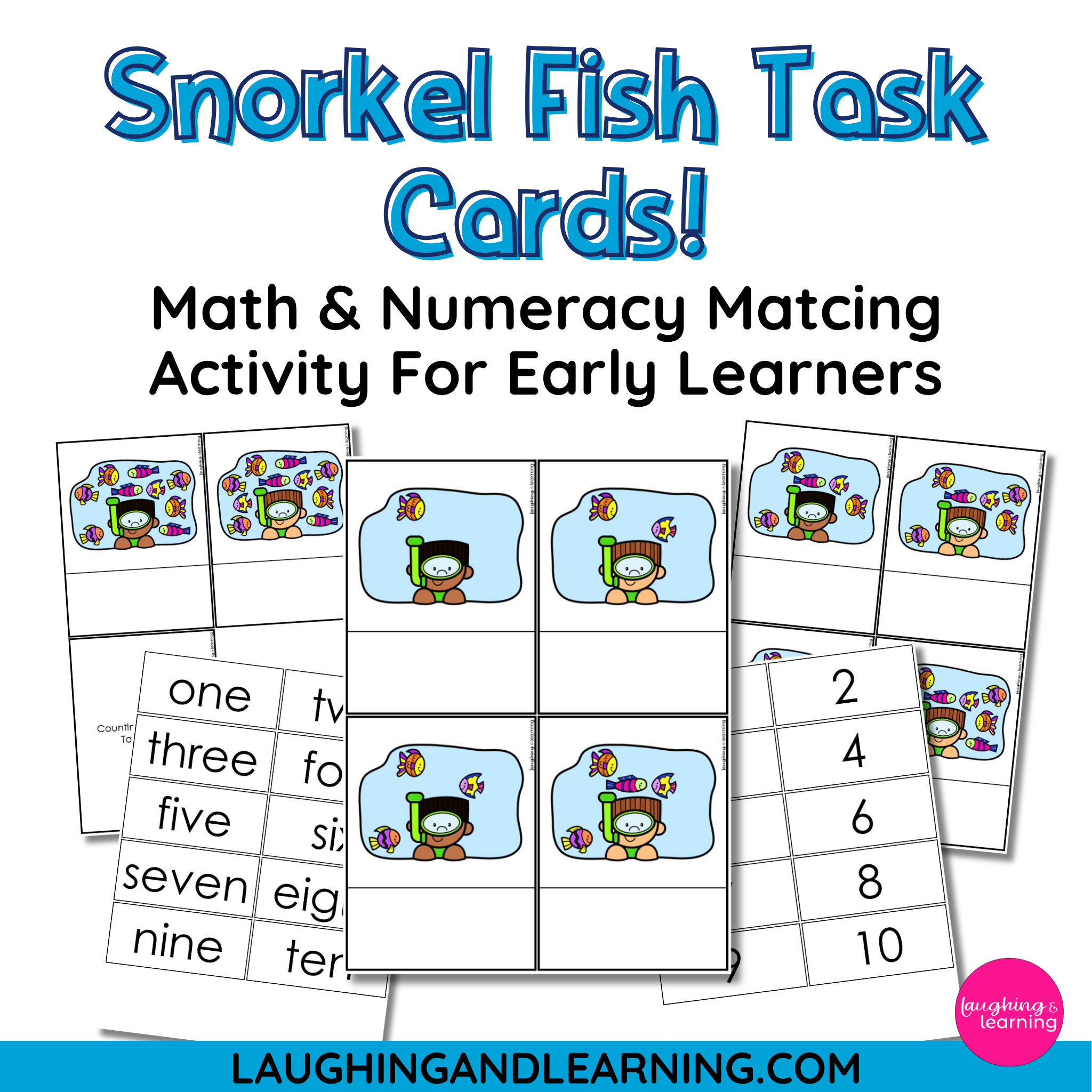
Counting is one of the first mathematical skills young children develop – but true counting fluency involves more than reciting numbers in order. Children need to connect quantities to numerals, numerals to number words, and all three to the language of more, fewer, and equal. The Snorkel Fish Counting Task Cards are a printable counting task cards for preschool resource that builds all of these connections at once, through a cheerful snorkelling theme that brings a splash of summer energy to your math centre.
Ten picture counting cards – each featuring a snorkeller surrounded by colourful tropical fish to count – are matched to numeral cards and number word cards covering 1 to 10. The three-card matching format makes this resource uniquely rich: children are not just counting pictures, they are also reading numerals, recognising number words, and building the multi-representational number sense that underpins all future mathematics learning.
Designed for children ages 3–6, this resource works beautifully in preschool and Pre-K math centres, kindergarten classrooms, summer-themed learning units, and at-home math routines.
What Are the Snorkel Fish Counting Task Cards?

The Snorkel Fish Counting Task Cards are a three-part card set covering numbers 1 to 10. Each number has three matching cards: a picture counting card showing a group of snorkel fish to count, a numeral card showing the digit (1–10), and a number word card showing the written word (one–ten). Children match all three cards together to complete each number’s trio.
The counting pictures are clear and easy to count – fish displayed in accessible arrangements against a bright underwater background, with a friendly snorkeller character on each card. The numeral cards and number word cards are clean and legible, making the visual task of matching straightforward and satisfying.
An optional self-check dot can be added to the back of each matching trio, so children can verify their own work independently – a feature that supports self-correction and builds mathematical confidence without requiring constant adult oversight.
The resource includes:
- 10 picture counting task cards (1–10) featuring groups of snorkel fish
- 10 matching numeral cards (1–10)
- 10 matching number word cards (one–ten)
- A teacher guide covering three match-it options, three centre variations, four differentiation and extension strategies, and teacher talk prompts
Three Match-It Options Built Into the Resource
What makes these counting task cards for preschool more than a basic counting activity is the three distinct matching modes built into the resource. Each one uses the same cards but develops a different mathematical connection.

Numeral to Picture Place numeral cards face up and match the counted picture cards to the correct numeral. This is the foundational match – connecting the quantity shown in the picture to the symbol that represents it. Children count the fish, say the number, and find the digit that matches.
Word to Picture Match number-word cards to the counted pictures. This mode adds a literacy integration layer, building early number word recognition alongside counting. Children encounter words like seven and nine in a mathematical context, strengthening the connection between reading and numeracy.
Numeral to Word Match numeral cards to number word cards directly – no picture involved. This is the most abstract of the three modes and the most appropriate for children who have already built confident counting and numeral recognition skills. It is a natural bridge toward reading number words in everyday texts.
Three Centre Variations to Keep Learning Fresh
Three built-in centre variations give this resource extended staying power across a full school year.
Number Line Arrange numeral cards 1–10 in order and slide each picture card under the matching number. This sequencing task develops number line awareness and the understanding that numbers have a fixed, ordered position – a concept that underpins addition, subtraction, and measurement later in schooling.
Write the Room / Scoot Tape picture cards around the classroom. Children move from card to card with a clipboard, recording the numeral that matches each picture. This active, movement-based variation is particularly effective for kinaesthetic learners and adds energy and variety to the math centre rotation.
Memory Use any two of the three card types – turn them face down and flip pairs to find matches. This classic game format builds working memory and number recognition fluency while keeping the activity feeling fresh and fun across repeated sessions.
Skills These Counting Task Cards for Preschool Build

The Snorkel Fish Counting Task Cards develop a rich cluster of early math and cognitive skills through every mode of engagement.
Early Math Foundations Children count with one-to-one correspondence, build cardinality (understanding that the last number counted represents the total), recognise numerals 1–10, read number words one through ten, compare quantities (more/fewer/equal), and practice ordering from least to most. These are precisely the numeracy skills that the early years mathematics curriculum is built upon.
Cognitive and Executive Function Visual discrimination between similar quantities, working memory while tracking counts across the picture cards, and self-correction via the optional self-check dot – all of these executive function skills are exercised naturally through repeated, purposeful engagement with the matching task.
Language and Communication Math talk is built into the activity: counting language, comparative vocabulary (equal, fewer, more), and the language prompt “I have more because…” These conversation starters – included in the teacher guide – develop mathematical reasoning alongside number knowledge.
Fine Motor Development Handling, sorting, and placing cards builds pincer grasp, hand strength, and bilateral coordination. If clips are used to mark correct matches, the fine motor demand increases further – a useful addition for children who need extra grip strengthening work.
Social-Emotional Learning Cooperation during partner and centre play, and the confidence that comes from successful matching, develop alongside the mathematical skills. Both are noted in the resource’s targeted behaviours – a reminder that math learning and social-emotional development are never truly separate in the early years.
Differentiation and Extensions

Four built-in strategies make this resource inclusive and adaptable across a wide range of numeracy development levels.
Narrow the Field – Start with numbers 1–5 and add 6–10 as confidence grows. Reducing the number range lowers the cognitive load and lets beginning learners experience success before the full set is introduced.
Counters – Provide small manipulatives so children can physically count out objects that match each picture card. This concrete support bridges the transition from counting real objects to counting pictured quantities. A crucial developmental step that many children need more time with.
One More / One Less – After answering, show the new number. “If there are 6 fish, what comes next? What comes before?” This extension develops flexible number thinking and lays early groundwork for addition and subtraction concepts.
Subitizing Talk – Ask: “How did you know without counting each one?” This prompt encourages children to notice patterns and groups within quantities. Rather than always counting from one – a key early numeracy habit that supports future mental math fluency.
Preparation Tips
Getting this resource ready takes just a few minutes.
- Print all card pages on cardstock for durability.
- Laminate if you would like long-term, wipe-clean use.
- Cut out number word cards and number cards – do not cut the counting task cards with pictures.
- Match number cards to corresponding picture task cards.
- Add a small self-check dot to the back of each matching trio for independent use.
Once laminated, these cards hold up through an entire school year of daily use across all three match-it modes and three centre variations – a genuinely cost-effective early numeracy resource.
Why These Counting Task Cards for Preschool Work
Number sense is not built through a single skill. It develops through repeated exposure to quantities, numerals, and number language – across varied formats, in varied contexts, with varied levels of challenge. The Snorkel Fish Counting Task Cards provide exactly that kind of layered, flexible numeracy practice.

The snorkel fish theme is fresh, fun, and visually appealing without being distracting. The three card types mean every child is working with number in three different representational forms simultaneously. A depth of engagement that a standard count-and-match activity simply cannot provide. The three centre variations and four differentiation strategies mean the same set of cards serves children. From the very beginning to early subitizing and number word reading.
For educators, this resource slots cleanly into existing math centre rotations without additional planning. For parents, it is a print-and-play activity that brings real numeracy depth to at-home math learning. And for children, counting fish, finding and the matching number – is a delightful way to build the foundations of mathematical thinking.
Get the Snorkel Fish Counting Task Cards
Ready to bring these counting task cards for preschool into your learning space? The Snorkel Fish Counting Task Cards are available as a digital download from Laughing and Learning. Print, laminate, and watch your little learners dive deep into counting – one fish at a time.

Looking for More Summer Hands-On Activities?
If your learners enjoy these Snorkel Fish Task Cards, you will find many more hands-on resources in the Laughing & Learning shop. Happy learning!
If you use this in your classroom or at home, I’d love to hear how it went! Drop a comment below or tag me on Instagram. 🌸