
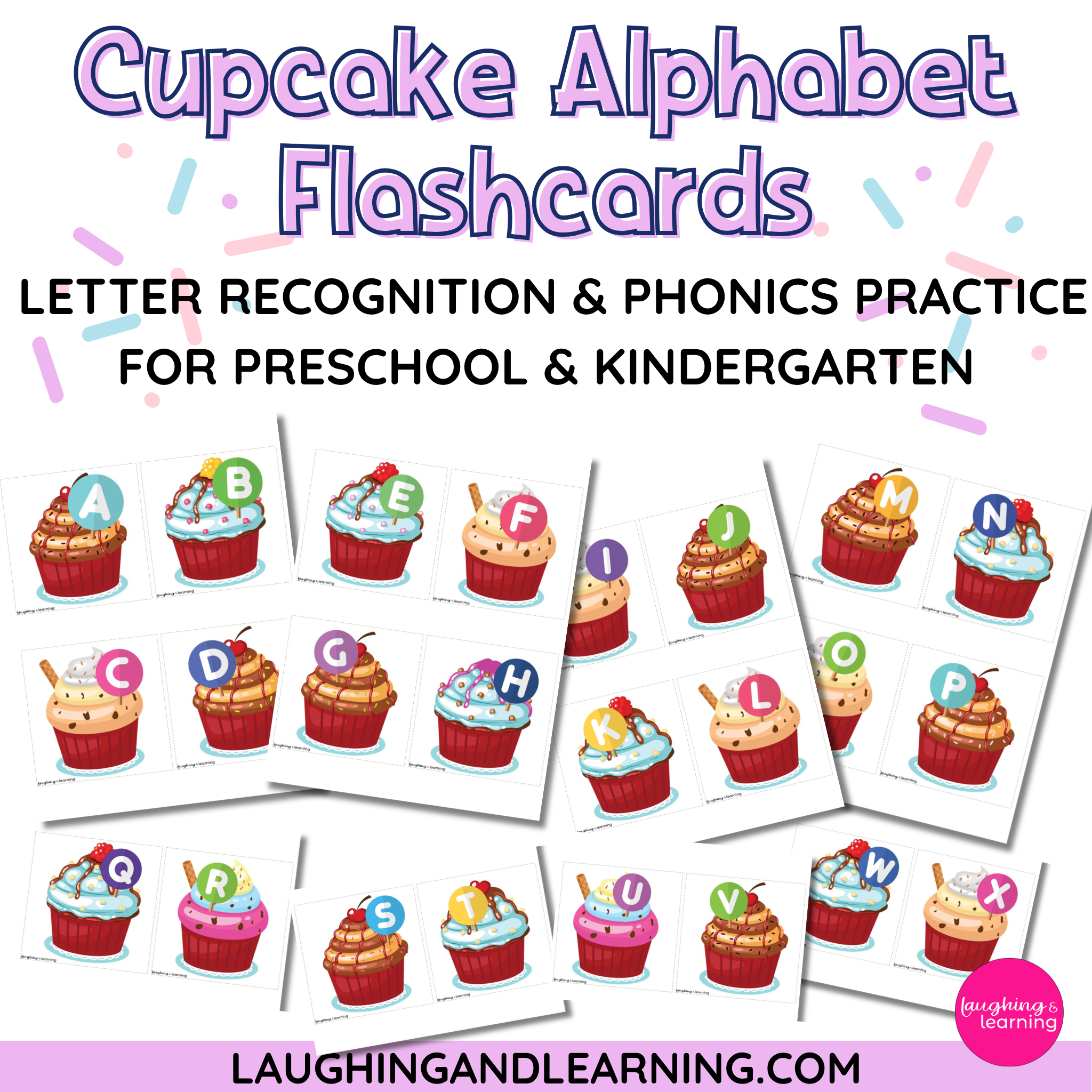
A great set of alphabet flashcards does more than sit on a ring and get flipped through once a day. In the right hands, with the right activities built around them, a beautifully designed card set becomes one of the most flexible, frequently used resources in an early literacy classroom. The Cupcake Alphabet Flashcards are exactly that kind of resource. Twenty-six uppercase letter cards – each featuring a richly illustrated cupcake topped with a bold, colourful letter – bring together visual delight and purposeful literacy learning in a format that children ages 3–6 will want to reach for again and again.
These alphabet flashcards for preschool and kindergarten are not a passive resource. Six structured engagement modes, five differentiation strategies, and a card design that supports everything from ABC order to word building make this one of the most versatile literacy tools in the Laughing and Learning collection.
What Are the Cupcake Alphabet Flashcards?

The Cupcake Alphabet Flashcards are a set of 26 uppercase letter cards, one for each letter A–Z. Each card features a beautifully detailed cupcake illustration – in flavours and frosting styles that vary across the set – with a large, clearly coloured letter displayed prominently on each cupcake. The letters are displayed in bold, distinct colours across the alphabet, making the full set visually vibrant and easy to scan.
Each card trims to a uniform size along the outer guidelines, creating a consistent, professional card set that works equally well spread across a table, arranged in a pocket chart, or taped around the classroom for a scoot activity. Print duplicates of commonly used letters (m, s, t, n, p, c, r, l) for word-building and name centre work.
The resource includes:
- 26 uppercase (A–Z) letter cards with cupcake-themed design
- Cutting guides for uniform card size
- A comprehensive teacher guide covering six activity modes, five differentiation and extension strategies, and teacher talk prompts
Four Ways to Use These Alphabet Flashcards for Preschool and Kindergarten

The four structured activities built into this resource are what elevate it from a decorative card set into a genuine literacy tool. Each mode targets a different skill – and each one uses the same 26 cards.
Sound Sort (Teacher-Led or Independent) Choose 3–6 letter headers and spread them out. Say a word aloud and have learners pick the matching cupcake letter card with that initial sound. This activity directly develops letter-sound correspondence and initial-sound isolation – two of the most important phonemic awareness skills in early literacy development.
Memory / Concentration Print a second copy of the cards, turn all cards face down, and flip two at a time to find matching pairs. This classic game format builds working memory and letter recognition fluency in a format that children find genuinely exciting. It also works beautifully as a partner activity, adding a social layer to the learning.
Word-Building Centre (Print Duplicates) Provide multiple copies of high-frequency letters. Build CVC words (cat, pin, sun), names, or cupcake-themed words. Add picture cards you already own as prompts. This extension moves children from letter recognition into early word construction – a meaningful bridge toward reading and spelling independence.
Name Centre Give each child the cupcake cards for the letters in their name, mix them up, and have children order them correctly. Then find each letter’s uppercase or lowercase partner. There is no more personally meaningful literacy task for a young child than working with the letters of their own name – and the cupcake cards make that task feel special.
Skills These Alphabet Flashcards for Preschool and Kindergarten Build

Every activity in this resource develops literacy skills across multiple domains – making each session genuinely productive.
Early Literacy and Phonics Children build letter recognition across the full uppercase alphabet, develop letter-sound correspondence, and practise initial-sound isolation through the Sound Sort activity. These foundational skills predict early reading success more strongly than almost any other early childhood measure.
Cognitive and Executive Function Sorting and classifying letters, visual discrimination of confusable letter pairs (b/d, p/q, m/n, u/v), working memory during the Memory game, and self-correction when a sort does not look right – all of these executive function skills develop naturally through repeated, purposeful engagement with the cards.
Language and Communication The activities generate rich vocabulary development through sound and word examples, and build conversational skills through turn-taking and explaining choices. Teacher talk prompts included in the resource keep language purposeful: “What sound does this letter make at the start of ___?” / “Show me its partner — uppercase or lowercase.” / “Which letters are tricky for you? How can we remember them?”
Fine Motor Development Handling, sorting, and placing cards builds pincer grasp and hand manipulation skills. The write extension and scoot activity add pencil-control practice alongside the letter recognition work.
Differentiation and Extensions
Five built-in strategies make this resource inclusive and adaptable across a wide range of early literacy levels.

Narrow the Field – Start with 6–8 letters featuring distinct, frequently occurring sounds. Add more as confidence and accuracy grow. Beginning learners are never overwhelmed by the full alphabet before they are ready for it.
Confusables Coaching – Provide extra practice with the most commonly reversed or confused letter pairs: b/d, p/q, m/n, u/v. Use finger-tracing and sky/grass/ground cues to build reliable visual memory for these tricky letters. Consistent, explicit coaching on confusables is one of the highest-leverage moves in early phonics instruction.
Multi-Sensory – After matching or sorting, trace the letter in a sand tray, a salt tray, or on a whiteboard. This tactile reinforcement deepens the neural connections between seeing, saying, and forming each letter – supporting both recognition and formation simultaneously.
Formation Link – After matching, write both the uppercase and lowercase form of the letter three times each. This natural extension connects the card activity to handwriting practice without requiring additional resources.
Speed Sort – Time how quickly a learner can sort a mixed pile of duplicate cards into their correct letter groups. This fluency challenge adds motivation for confident learners and provides a simple, built-in measure of letter recognition automaticity.
Preparation Tips
Getting this resource ready is straightforward and quick.
- Print all pages on cardstock for durability.
- Laminate each page for long-term, wipe-clean use.
- Cut along the outer guidelines to create uniform card size.
- Print duplicates of commonly used letters (m, s, t, n, p, c, r, l) for word-building and name centre tasks.
- Store cards in a small bin or labelled ziplock bag for easy access during centre setup.
Once laminated, these cards hold up through a full school year of daily use across all six activity modes. The print-duplicate option for word building means the same resource grows naturally with children’s skills as the year progresses..
Why These Alphabet Flashcards for Preschool and Kindergarten Work

A beautifully designed card is not just aesthetically pleasing – it is pedagogically important. Young children are drawn to detail, colour, and novelty. The Cupcake Alphabet Flashcards give them something genuinely lovely to look at, which means they look longer, engage more deeply, and return more willingly. That sustained engagement is what allows the learning to happen.
The six activity modes ensure the same 26 cards never feel repetitive. From a quiet ABC order task on a Monday morning to a lively scoot-the-room activity mid-week to a partner memory game at the end of the day, the cards flex across moods, group sizes, and instructional goals without requiring additional materials. The five differentiation strategies mean every child – from a child who knows six letters to a child who is ready to build CVC words – has a genuinely appropriate, appropriately challenging way to engage with the same card set.
For educators, this resource integrates cleanly into existing literacy routines without extra planning. For parents, it is a print-and-play set that turns alphabet learning at home into something children request. And for children, picking up a beautifully frosted cupcake card to spell their name or sort sounds is simply a wonderful way to begin learning to read.
Get the Cupcake Alphabet Flashcards

Ready to bring these alphabet flashcards for preschool and kindergarten into your learning space? The Cupcake Alphabet Flashcards are available as a digital download from Laughing and Learning. Print, laminate, and watch your little learners sweeten their way through the alphabet – one cupcake at a time.
Looking for More Hands-On Activities?
If your learners enjoy these Cupcake Alphabet Flashcards, you will find many more hands-on resources in the Laughing & Learning shop. Happy learning!
If you use this in your classroom or at home, I’d love to hear how it went! Drop a comment below or tag me on Instagram. 🌸