
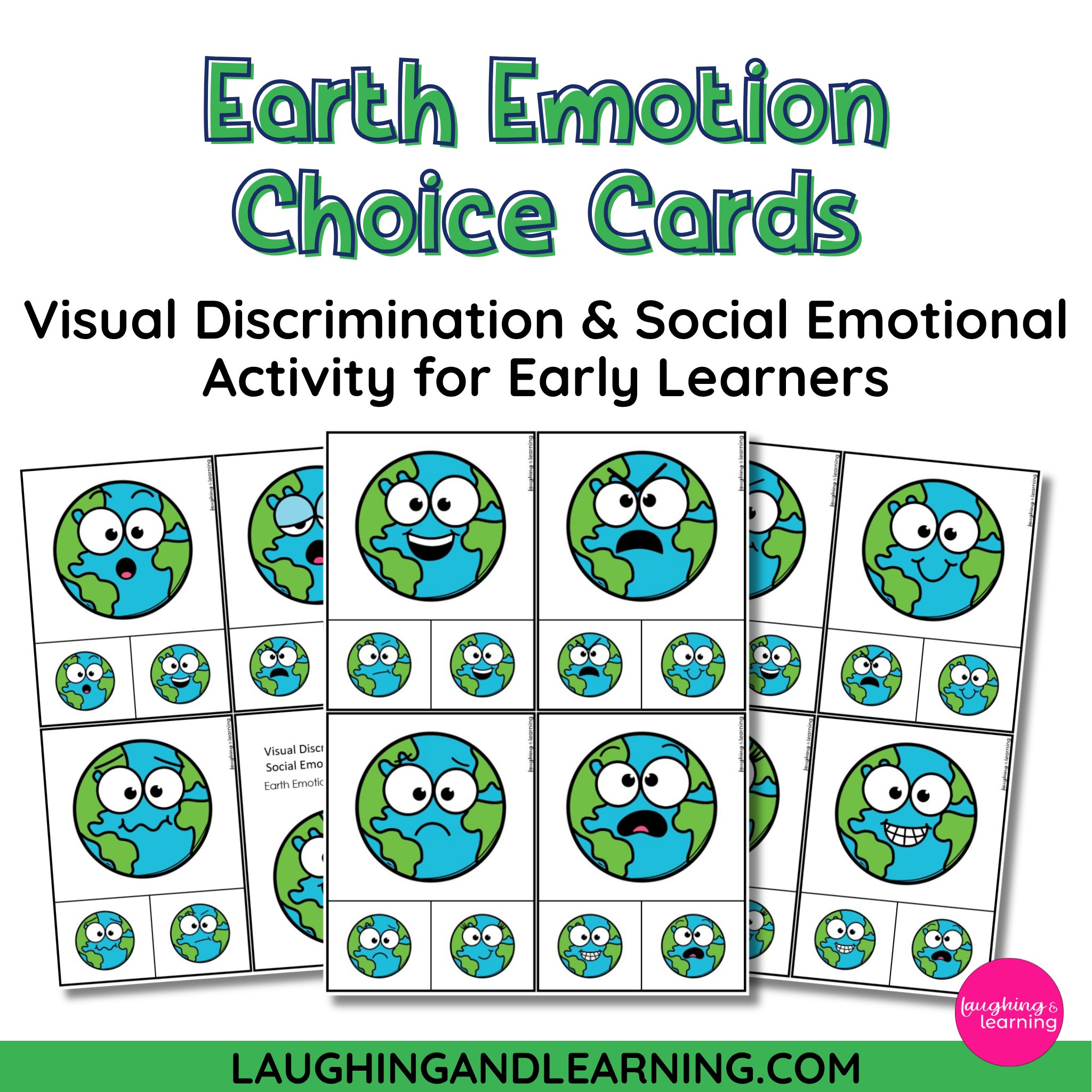
Earth Day and social-emotional learning make a more natural pairing than you might expect. Both invite children to look carefully at the world around them, to notice what they see, and to respond with care and intention. The Earth Emotion Choice Cards bring these two themes together in one thoughtfully designed printable resource. A Earth Day emotions activity for preschool that builds visual discrimination skills and emotional literacy through the same cheerful globe characters children already love from the Earth Emotions Puzzle.
This card-based activity takes a different approach to emotion learning. Rather than assembling puzzle pieces, children study expressive earth faces, compare them side by side, and make deliberate choices about what they see. It is the kind of resource that sharpens both the eyes and the heart – and it works beautifully whether it lives in a dedicated Earth Day unit or simply in your year-round SEL centre.
Designed for children ages 3–6, the Earth Emotion Choice Cards suit preschool and Pre-K classrooms, kindergarten literacy and SEL centres, speech and language support settings, and at-home emotional learning routines.
What Are the Earth Emotion Choice Cards?

The Earth Emotion Choice Cards are a set of printable cards featuring expressive globe characters, each displaying a distinct facial expression. The familiar blue-and-green earth design gives each card an instantly recognisable, planet-themed look that is visually engaging and thematically coherent.
Each card shows globe characters with emotions including happy, sad, angry, surprised, worried, silly, smirking, and more. The expressions are drawn with clear, readable facial features – eyes, eyebrows, and mouths that children can study and compare. The card format, with one large main image and smaller reference images below, is structured to support multiple modes of engagement across four core activities.
The resource includes:
- Earth emotion cards showing distinct facial expressions
- Trim guides for quick preparation
- A comprehensive teacher guide covering four core tasks, three variations and extensions, differentiation strategies, and teacher talk prompts
Four Core Activities Built Into the Resource

What distinguishes this Earth Day emotions activity for preschool from a standard flashcard set is the structured, multi-mode engagement built directly into the resource. The same set of cards supports four meaningfully different learning experiences.
Core Match: Find the Same The child looks at a target earth card and finds the matching globe from a set. This is the foundation of the activity – pure visual discrimination requiring careful observation and comparison of facial features. It is accessible to beginning learners and builds the scanning habits that underpin more complex tasks.
Find the Different (Odd One Out) The child is presented with a group of globe cards and must identify the one that does not match the others. This task demands sustained attention, strategic scanning, and the ability to hold multiple visual details in working memory at once. It is a genuine executive function challenge wrapped inside a friendly, earth-themed activity.
Feel and Tell (Language Link) After each match, the child names the feeling shown and completes a sentence stem: “I feel angry when _” or “I felt proud when _.” This bridges visual discrimination with expressive language and emotional self-reflection – moving children from simply recognising a feeling to connecting it to their own lived experience.
Act and Match (Charades) The child uses their face and body to act out an emotion while peers scan the cards to find the matching earth and name the feeling. An optional mirror allows children to observe their own expressions. This kinaesthetic, social mode of engagement is especially powerful for active learners and builds empathy alongside self-awareness.
Skills This Earth Day Emotions Activity for Preschool Develops
The Earth Emotion Choice Cards target multiple developmental domains at once – a hallmark of truly efficient early childhood resources.
Language and Communication Children practise descriptive language as they articulate what they notice in each globe face: the angle of the eyebrows, the shape of the mouth, the position of the eyes. They also use sentence stems to share their own feelings, building both vocabulary and the conversational turn-taking that supports strong communication development.
Cognitive and Executive Function Visual discrimination of subtle facial features is the core cognitive skill throughout. Children also develop strategic scanning – the habit of looking systematically rather than randomly – along with working memory and self-correction. The Find the Different task is particularly rich in executive function demands, requiring children to consider and revise their thinking when an initial choice turns out to be wrong.
Social-Emotional Learning Across all four activities, children build emotion recognition from facial cues, develop emotion vocabulary and labelling skills, practise empathy, and begin to connect feelings to self-regulation strategies. The Feel and Tell prompts – “What helps you when you feel _?” – plant seeds for the kind of emotional intelligence that shapes how children relate to themselves and others for years to come.
Variations and Extensions to Deepen the Learning

Three built-in extensions give this resource additional reach without requiring any extra materials.
Coping Coach – For “tricky” feelings like sad, angry, and worried, pair each globe card with one coping strategy: belly breaths, asking for help, finding a quiet corner. This connects emotion recognition directly to self-regulation thinking, making the activity a practical tool for emotional coaching conversations. Especially relevant in an Earth Day context where discussions about caring for difficult feelings mirror conversations about caring for the planet.
Story Starter – Choose three emotion cards and invite the child to tell a short story that includes all three feelings. This creative extension builds narrative thinking and sequencing skills and deepens children’s understanding that emotions shift and layer throughout a single experience.
Memory / Concentration – Place exact pairs face down and flip two at a time to find matching expressions. This classic game format builds working memory and sustained attention while keeping the emotion recognition practice fresh and engaging across multiple sessions.
Differentiation for Every Learner

This resource is designed to flex across a wide range of ability levels.
Narrow the Field – Start with just 3–4 core emotions: happy, sad, angry, and surprised. As the child’s visual discrimination skills grow, introduce look-alike pairs – similar expressions that require more careful comparison to distinguish. This gradual approach builds confidence before complexity.
Visual Supports – Keep emotion word cards and cartoon mouth and eyebrow icons nearby as scaffolds. These reference tools support children who are still learning to connect the visual image to the emotion name, and they fade naturally as children internalise the associations over time.
Think-Aloud – Model precise noticing consistently with beginning learners: “Let’s look at the eyebrows first. Are they slanted in or raised up? Now let’s look at the mouth.” Teaching children a reliable scanning sequence gives them a transferable strategy for reading facial expressions – in the cards, in books, and in real life.
For advanced learners, the Story Starter and Coping Coach extensions provide meaningful challenge. Asking children to justify their choices – “How do you know this earth is worried and not scared?” – pushes thinking to a metacognitive level that builds sophisticated emotional reading skills.
Preparation Tips
Getting these cards ready takes just a few minutes.
- Print all card pages on cardstock for durability.
- Laminate each page for long-term, wipe-clean use.
- Cut along the trim lines to separate individual cards.
- Store cards in a small bin, ziplock bag, or labelled envelope for easy access.
Once laminated, these cards are ready for daily use throughout the entire school year – and well beyond. The four activity modes mean the same set of cards stays purposeful and varied through dozens of repetitions, making this one of the most cost-effective resources in your SEL toolkit.
Why This Earth Day Emotions Activity for Preschool Works

Earth Day invites us to look more carefully at the world we share – to notice what is there, to value it, and to respond with care. The Earth Emotion Choice Cards carry that same invitation into the emotional world. Children who use this resource are practising something more than emotion recognition. They are learning to look closely, to compare thoughtfully, and to put language to what they find.
The globe characters are expressive and instantly appealing. Their clear facial features make each emotion readable without oversimplifying the emotional distinctions children need to notice. The card format is structured without being rigid – it supports four distinct activities, three extensions, and differentiated approaches that can be adjusted in seconds. And the Earth Day theme makes this resource a natural fit for April learning units, and environmental topics.
For educators, it integrates cleanly into existing SEL and Earth Day routines without requiring scripted lessons or extensive setup. For parents, it is a versatile, print-and-play card set that opens up meaningful feeling conversations at home. And for children, studying a surprised or smirking earth – is both a cognitive challenge and a genuinely enjoyable experience.
Get the Earth Emotion Choice Cards

Ready to bring this Earth Day emotions activity for preschool into your learning space? The Earth Emotion Choice Cards are available as a digital download from Laughing and Learning. Print, laminate, and help your little learners look closely, think carefully, and feel deeply – one globe at a time.
Looking for More Themed Activities?
If your learners loved these Earth Day Emotion Choice Cards, you’ll find even more resources in the Laughing & Learning shop! From printable worksheets to hands-on literacy and math activities, there’s something for every learner.
If you use this in your classroom or at home, I’d love to hear how it went! Drop a comment below or tag me on Instagram. 🌸