
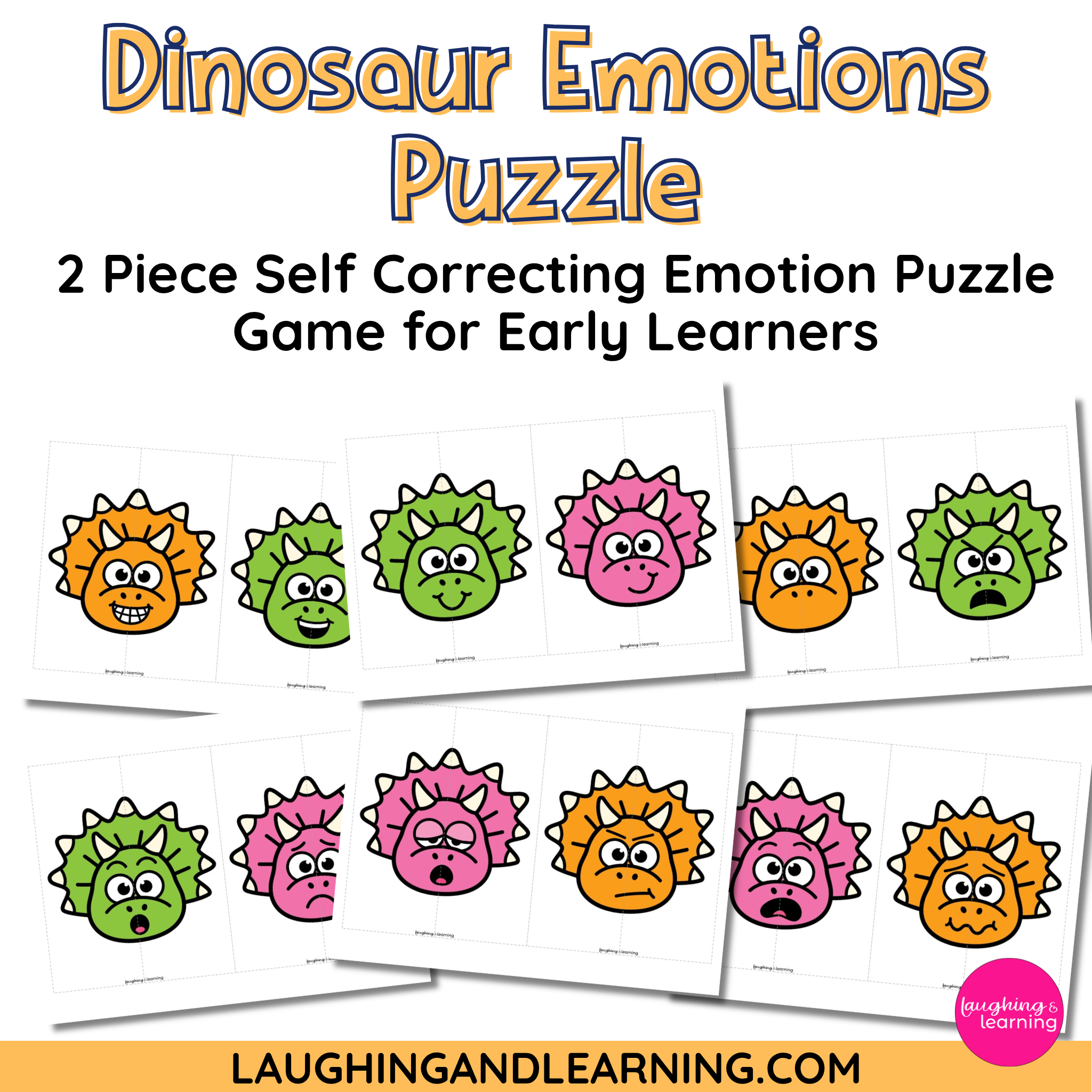
There are very few themes that capture the attention of young children the way dinosaurs do. The roar of a T-Rex, the spikes of a triceratops, the sheer prehistoric wonder of it all – dinosaurs have a magnetic pull on the preschool imagination. The Dinosaur Emotions Puzzle takes that enthusiasm and channels it directly into social-emotional learning. This printable dinosaur emotions activity for preschool features ten self-correcting two-piece puzzles, each shaped like an expressive triceratops character, giving children a hands-on, playful way to identify feelings and build the emotional vocabulary they need to thrive.
Designed for children ages 3–6, this resource is a natural fit for preschool and Pre-K SEL centres, kindergarten classrooms, dinosaur-themed units, and at-home emotional literacy routines. Whether your little learners are dinosaur obsessed or simply love a good puzzle, this activity delivers meaningful learning in a package they will be excited to open.
What Is the Dinosaur Emotions Puzzle?
The Dinosaur Emotions Puzzle is a set of ten self-correcting, two-piece puzzles. Each puzzle features an adorable triceratops face – in bold shades of orange, green, and pink – split vertically down the centre into a left half and a right half. Children assemble the two halves to complete each dinosaur’s facial expression and then identify the feeling it shows.

The triceratops characters are expressive and immediately readable. Their large eyes, furrowed brows, and dramatically shaped mouths make each emotion clear and distinct, even for children who are just beginning to develop emotional vocabulary. The bold colours across the set add visual variety and make sorting and matching feel like a vibrant, engaging experience.
The self-correcting design is one of the resource’s most valuable features. Each puzzle pair has a unique cut along the centre line, so every left half fits correctly only with its matching right half. Children can check their own work by seeing whether the face aligns – no adult verification needed. This independence builds problem-solving confidence and a genuine sense of ownership over the activity.
The ten puzzles cover a broad and nuanced range of expressions:
- Happy
- Sad
- Angry
- Surprised
- Silly
- Worried
- Smirking
- Grinning
- And more
The resource includes:
- 10 self-correcting two-piece dinosaur emotion puzzles
- A teacher guide with instructions, targeted skills, classroom centre ideas, extension activities, and differentiation strategies
Skills This Dinosaur Emotions Activity for Preschool Develops
The Dinosaur Emotions Puzzle is rooted in social-emotional learning, but it builds skills across multiple developmental domains – making it a genuinely efficient classroom resource.

Social-Emotional Learning Children practise recognising facial expressions, labelling emotions, developing empathy, and beginning to think about self-regulation. The included teacher talk prompts guide conversations that go deeper than simple identification: “What helps you when you feel _?” These questions plant seeds for the kind of emotional intelligence that supports children throughout their lives.
Language and Communication Assembling and discussing each dinosaur face naturally builds descriptive language. Children learn to look carefully and put words to what they observe: “I see raised eyebrows” or “his mouth looks like he’s frowning.” This kind of observational talk strengthens vocabulary and supports the conversational turn-taking that is central to early communication development.
Cognitive and Executive Function The self-correcting format requires visual discrimination – children must notice subtle differences between expressions to determine whether a match is correct. When pieces do not fit, they problem-solve and self-correct. Working memory is active throughout, as children track which halves they have already tried. These are core executive function skills built through purposeful, repeated practice.
Fine Motor Development Picking up, aligning, and placing puzzle pieces builds pincer grip, bilateral coordination, and hand-eye coordination. For young learners, these physical skills are just as important as the social-emotional ones – and this activity develops both at the same time.
How to Use This Activity in Your Classroom or Home
This dinosaur emotions activity for preschool is adaptable enough to fit naturally into a range of different instructional routines and settings.
Social-Emotional Learning Centre Place all puzzle pieces mixed together in a bin or basket. Children sort through the halves, assemble each dinosaur face, and name the emotion they have created. Because the self-correcting design allows children to check their own work, this centre runs smoothly without constant adult support.
Small Group Instruction Work through a selection of puzzles together in a small group. Hold up each completed dinosaur and open a gentle discussion: “Has anyone ever felt like this dino? What happened?” Small group settings create a safe space for children to practise emotional vocabulary with their peers and hear how others describe their own experiences.
Dinosaur-Themed Unit This resource is a natural companion to a dinosaur topic. Pair it with dinosaur-themed books, counting activities, and dramatic play to build a cohesive, immersive unit where emotional literacy is woven into the theme rather than taught in isolation.
Morning Tub Activity Set out two or three puzzles in a bin during arrival time for a calm, purposeful start to the day. Emotion-focused morning activities set an intentional, connected tone that can carry through the entire session.
Extensions to Deepen the Learning

Three optional extensions are included in this resource. Each one adds meaningful depth without requiring any extra materials.
Positive and Uncomfortable Feelings Sort – After completing the puzzles, children sort the finished dinosaur faces into two groups: feelings that feel comfortable (happy, silly, grinning) and feelings that feel uncomfortable (worried, angry, sad). This builds emotional categorisation skills and opens up an important conversation – that all feelings are real, valid, and worth naming, even the hard ones.
Mirror Practice – Provide a small mirror and invite children to make the same expression as their completed dinosaur. This embodied approach deepens the connection between the visual image and the felt experience of an emotion. It is also genuinely fun – watching a child roar and then pull a “worried dino” face in a mirror is one of those joyful classroom moments that makes SEL feel alive.
Word Card Match – Add printed emotion word cards to the activity and ask children to place the matching word beside each completed puzzle. This extension bridges social-emotional learning and early literacy, reinforcing both emotion vocabulary and word recognition in a single, integrated task.
Differentiation for Every Learner

Emotional development follows its own timeline, and this resource makes it easy to meet each child where they are.
Beginning Learners – Start with the three most recognisable expressions: happy, sad, and angry. Offer just two halves at a time – one left and one right – so children are not overwhelmed by sorting through the full set. Name the emotion together before and after assembling each puzzle, keeping the language simple and consistent.
Developing Learners – Introduce the full mixed set of ten puzzles and encourage children to sort and assemble independently. Prompt them to name each emotion as they complete it, and use the teacher talk prompts to spark a short personal connection: “Tell me about a time you felt surprised.”
Advanced Learners – After naming the emotion, ask children to describe what they notice about the dinosaur’s facial features: “What tells you this dino is worried? What do you see in the eyes? In the mouth?” This metacognitive layer builds sophisticated emotional reading skills. Pairing the completed puzzles with the word card extension provides an additional literacy challenge.
Preparation Tips
Getting this resource ready takes just a few minutes – and pays off for the entire school year.
- Print all puzzle pages on cardstock for durability.
- Laminate each page for long-term, wipe-clean use.
- Cut along the outer dashed rectangles to separate each puzzle card.
- Slice down the dotted centre line to divide each puzzle into its two halves.
- Store all pieces together in a small bin or ziplock bag, mixed for sorting practice.
Once laminated, these puzzles stand up to daily use throughout the school year without any additional preparation between sessions.
Why This Dinosaur Emotions Activity for Preschool Works

The best early childhood resources do two things at once: they capture children’s interest and deliver meaningful learning through that interest. The Dinosaur Emotions Puzzle does exactly that. The triceratops characters are bold, expressive, and immediately appealing to the children most likely to use this resource. The puzzle format adds a satisfying hands-on challenge. And the self-correcting design ensures that every child – regardless of ability level – can experience the confidence of getting it right independently.
Emotional literacy is not a supplementary skill. It is a core competency that shapes how children relate to themselves, to each other, and to the world around them. Building that literacy through a theme children already love – dinosaurs – makes the learning feel effortless. And effortless learning, in the early years, is the most powerful kind.
For educators, this resource integrates cleanly into SEL routines without needing scripted lessons or complex setup. For parents, it is a print-and-play activity that turns feelings conversations into something a child actively wants to participate in. And for children, putting together a roaring, smirking, or surprised dino face and naming what they see is simply a wonderful thing to do.
Get the Dinosaur Emotions Puzzle

Ready to bring this dinosaur emotions activity for preschool into your learning space? The Dinosaur Emotions Puzzle is available as a digital download from Laughing and Learning. Print, laminate, and let your little learners ROAR their way through the full range of feelings – one dino face at a time.
Looking for More Dinosaur Activities?
If your learners loved these Dinosaur Emotions Puzzles, you’ll find even more resources in the Laughing & Learning shop! From printable worksheets to hands-on literacy and math activities, there’s something for every learner.
If you use this in your classroom or at home, I’d love to hear how it went! Drop a comment below or tag me on Instagram. 🌸