
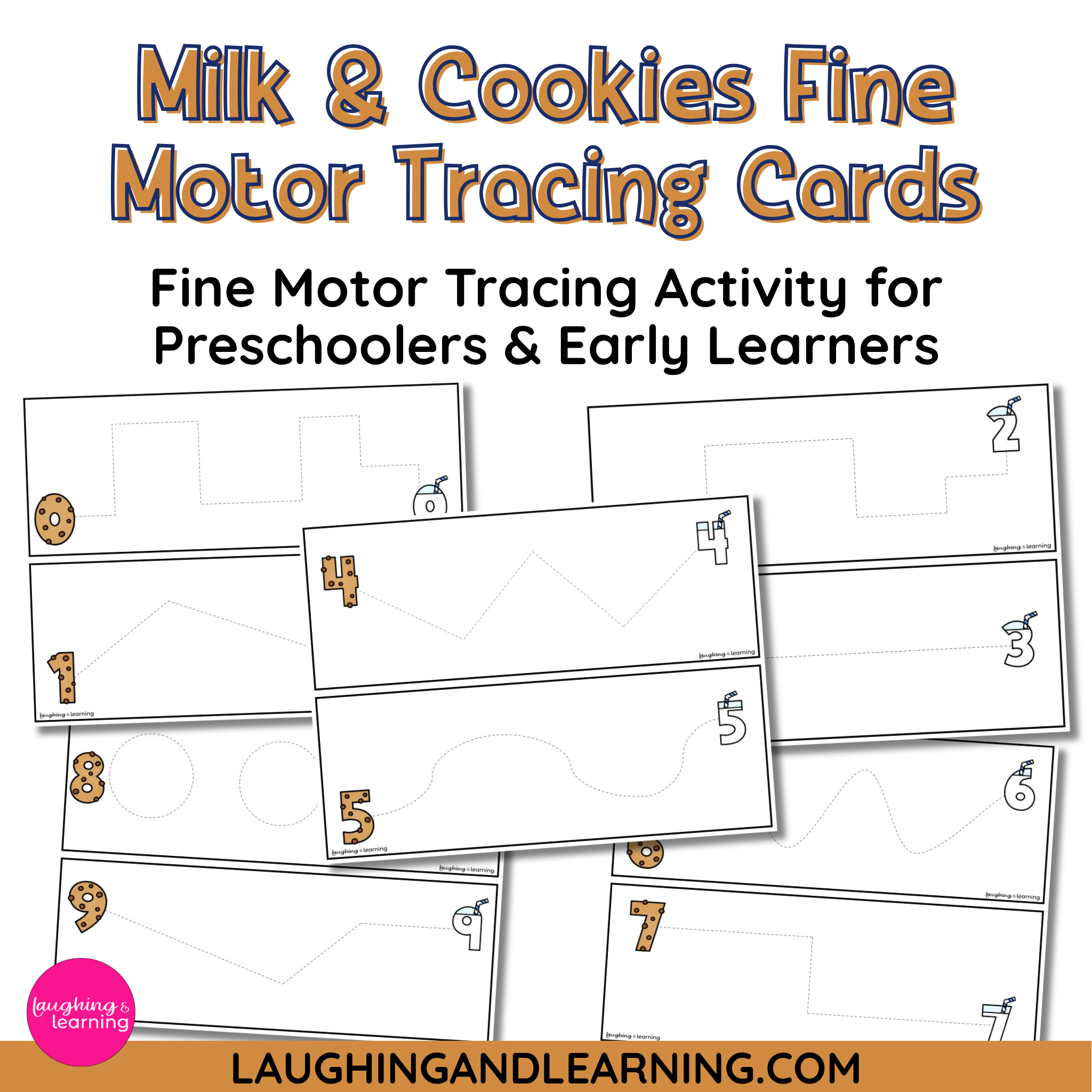
Before a child can write a letter, form a number, or hold a pencil with control, they need hundreds of small moments of practice. Those moments do not have to look like work. The Milk & Cookies Fine Motor Tracing Cards are a printable fine motor tracing activity for preschool that turns the essential early skill of pencil control into something children genuinely want to do – tracing a dotted path from a cookie number all the way to a matching milk carton number at the other end of the card.
The concept is simple, the theme is irresistible, and the developmental payoff is real. Designed for children ages 3–6, this resource works beautifully in preschool and Pre-K classrooms, kindergarten fine motor centres, and at-home learning routines. If you are looking for a tracing activity that is engaging, purposeful, and easy to prepare, this is it.
What Are the Milk & Cookies Fine Motor Tracing Cards?
The Milk & Cookies Fine Motor Tracing Cards are a set of ten horizontal tracing cards, one for each numeral from 0 to 9. Each card features a cookie-style number on the left side and a matching milk carton number on the right. Between them runs a dotted path that children trace from start to finish.

What makes this resource particularly well-designed is the variety of line paths across the ten cards. Rather than repeating the same straight line on every card, each number introduces a different tracing challenge:
- Straight horizontal lines
- Zigzag and angled lines
- Curved and wavy lines
- Circular and looping paths
- Stepped or staircase patterns
This variety is intentional. Different line types develop different aspects of fine motor control and pencil movement, giving children a more complete foundation for writing readiness than any single line type could provide on its own.
The resource includes:
- 10 tracing cards (0–9), each with a unique dotted line path
- A teacher instruction guide with engagement ideas, variations, and differentiation strategies
Skills This Fine Motor Tracing Activity for Preschool Builds
The Milk & Cookies Fine Motor Tracing Cards target a specific and important cluster of developmental skills – the ones that sit directly underneath early writing ability.

Fine Motor Development and Pencil Control Following a dotted path requires precise, controlled hand movements. Each time a child traces from cookie to milk, they are practising the grip stability, finger strength, and stroke control that underpin letter and number formation. Repeated tracing across varied line types builds genuine pencil fluency over time.
Hand-Eye Coordination Staying on the dotted line requires children to coordinate what they see with what their hand is doing. This visual-motor integration is a core component of writing readiness and one that develops only through consistent, hands-on practice.
Number Recognition Each card presents both a cookie numeral and a milk numeral – two visual representations of the same number. As children move from one end of the card to the other, they naturally reinforce their familiarity with each numeral. The tracing task and the number recognition task happen together, making this a genuinely cross-domain activity.
Focus and Task Persistence Tracing from one end of a card to the other requires sustained attention. Children must stay on the line, resist rushing, and see the task through to the end. These are habits of mind that matter well beyond the fine motor context.
Writing Readiness All of the above comes together in writing readiness – the bundle of physical and cognitive skills that prepares children to form letters and numbers with intention. This resource builds those skills systematically, one card at a time.
How to Use This Activity in Your Classroom or Home
This fine motor tracing activity for preschool is flexible by design. It fits naturally into several different routines without requiring any special setup.
Fine Motor Centre Place the laminated cards in a tray with dry-erase markers and an eraser cloth. Children choose a card, trace the path, wipe it clean, and choose another. The self-erasing format makes this a low-maintenance, high-engagement centre that runs independently.
Small Group Instruction Work through a selection of cards together in a small group, observing pencil grip, stroke direction, and line control. This is the ideal time to prompt proper technique before children practise independently: “Let’s trace slowly and stay on the line.” / “Can you follow the path all the way to the milk?”
Morning Tub Activity Set out two or three cards in a bin during arrival time for a quick, purposeful fine motor warm-up. Morning tub activities that are calm and achievable help children settle into the school day with focus.
Independent Work Station Once children understand the routine, the tracing cards work well as an independent task. A single card at a time is a manageable, confidence-building goal for early learners.
Variations and Extensions to Keep the Activity Fresh

A laminated set of tracing cards is a versatile tool. These five variations extend the activity across different learning modes without requiring additional materials.
Finger Trace – Before picking up a marker, the child traces the path with their index finger. This is an excellent first step for beginners who are still developing pencil grip confidence.
Marker Trace – The child traces the dotted path using a dry-erase marker, focusing on staying on the line without lifting the marker.
Manipulative Walk – The child moves a small object – a pom-pom, a mini cookie counter, or a toy car – along the dotted path. This variation is especially engaging for children who are not yet ready for marker work.
Number Naming – Before tracing, the child says the number aloud. This simple addition reinforces number recognition and connects the fine motor task to early numeracy.
Counting Extension – After tracing, ask the child to count out small objects that match the number on the card. This bridges fine motor practice with mathematical thinking in a natural, low-pressure way.
Differentiation for Every Learner
Every group of early learners includes children at different stages of fine motor development. This resource makes differentiation straightforward.
Beginning Learners – Focus on numbers 0–3 first, and allow children to finger trace before using a marker. Starting with simpler line paths – the straight and gently curved cards – builds early confidence. There is no rush to introduce the full set until a child is ready.
Developing Learners – Ask the child to identify the number before tracing, then encourage tracing without lifting the marker. The “no lift” challenge is a small but meaningful addition that develops stroke fluency and control.
Advanced Learners – Ask the child to say the number, trace it, and then draw the number independently on a whiteboard or piece of paper. This extension moves from guided tracing into independent mark-making – a significant step toward writing readiness.
Preparation Tips

Getting these cards ready is quick and simple.
- Print all cards on cardstock for durability.
- Laminate each card for repeated use with dry-erase markers.
- Store the cards in a small bin, ring binder, or labelled envelope.
- Keep a set of dry-erase markers and a soft cloth nearby for easy wiping.
Laminated tracing cards are one of the most practical investments in an early childhood classroom. Once prepared, they require no additional setup and can be used daily for an entire school year – and beyond.
Why This Fine Motor Tracing Activity for Preschool Works

Writing readiness is not built in a single session. It develops gradually, through repeated exposure to activities that challenge small hands in meaningful ways. The Milk & Cookies Fine Motor Tracing Cards work because they make that repetition feel enjoyable rather than rote.
The cookie-to-milk concept gives each tracing task a clear beginning, middle, and end. The variety of line paths keeps each card feeling slightly different from the last. And the milk and cookies theme – warm, familiar, and a little bit fun – creates the kind of positive emotional context where young children engage most deeply.
For educators, these cards integrate seamlessly into existing fine motor routines. For parents, they offer a structured at-home tracing activity that is print-and-play simple. And for children, tracing the path from a cookie number to a milk number is simply a satisfying thing to do – which is exactly the point.
Get the Milk & Cookies Fine Motor Tracing Cards

Ready to bring this fine motor tracing activity for preschool into your learning space? The Milk & Cookies Fine Motor Tracing Cards are available as a digital download from Laughing and Learning. Print, laminate, and watch your little learners build the pencil control and writing readiness they need – one dotted path at a time.
Looking for More Themed Activities?
If your learners loved these Milk and Cookies Fine Motor Tracing Cards, you’ll find even more resources in the Laughing & Learning shop! From printable worksheets to hands-on literacy and math activities, there’s something for every learner.
If you use this in your classroom or at home, I’d love to hear how it went! Drop a comment below or tag me on Instagram. 🌸