
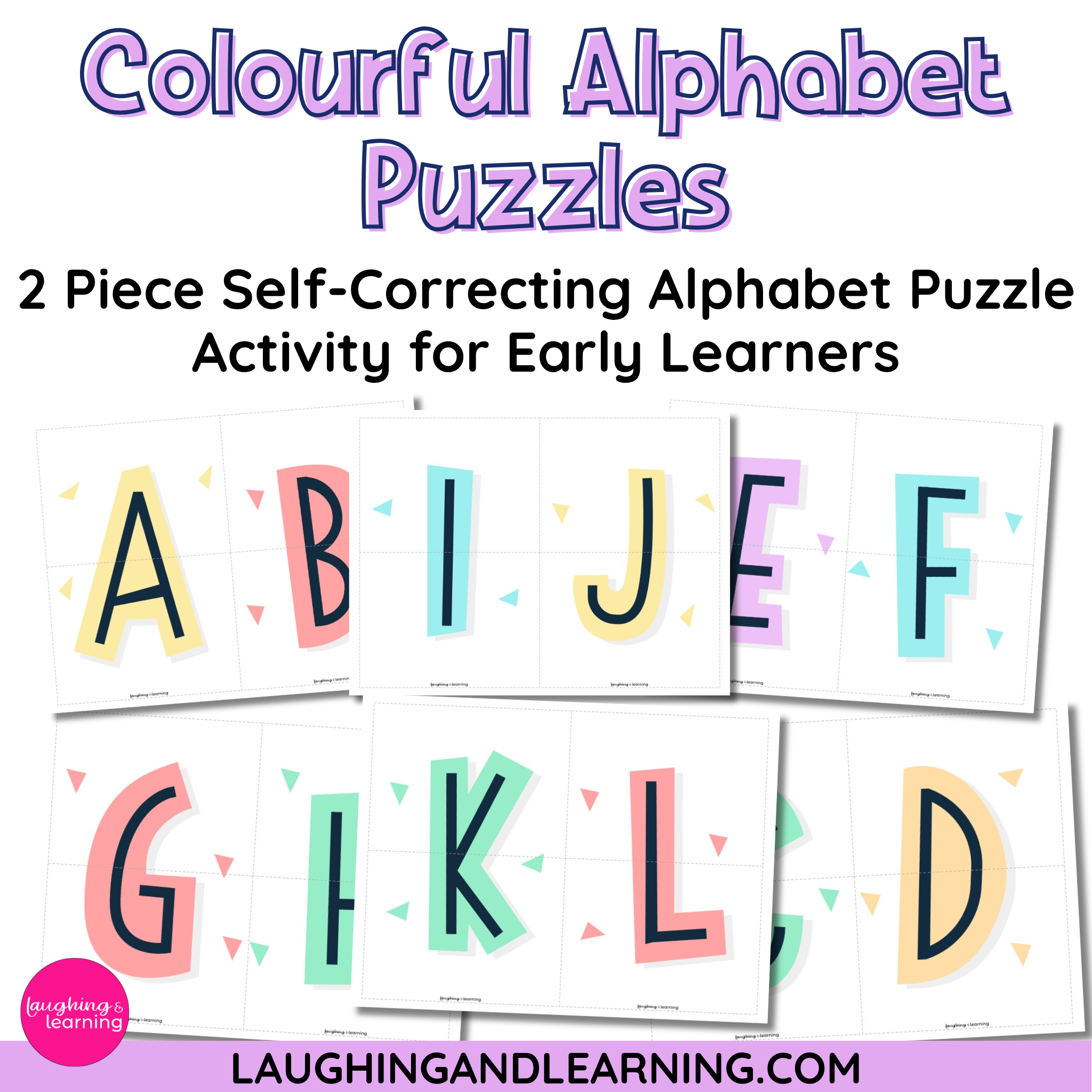

Not every literacy resource needs a seasonal theme to be effective. Sometimes a clean, bright, cheerful design is exactly what a classroom needs – and these colourful alphabet puzzles deliver just that. Featuring bold uppercase letters set against soft pastel backgrounds with playful triangle confetti accents, this 2-piece self-correcting puzzle set is visually appealing, educationally purposeful, and perfectly suited to year-round use.
Designed for children aged 3 to 6, this resource works beautifully in Preschool, Pre-K, and Kindergarten literacy centres across every season and theme unit.
What Are Colourful Alphabet Puzzles?
These colourful alphabet puzzles are 2-piece, self-correcting matching activities that cover all 26 uppercase letters of the alphabet. Each puzzle features a large, clearly printed letter split across two cards. The pieces are uniquely cut so that each letter only fits with its correct match – allowing children to check their own work without needing adult support.
The design uses a soft pastel palette – pinks, yellows, purples, teals, and greens – paired with bold navy letter forms that are easy to read and visually distinct. The small triangle accents scattered across each card add a fun decorative touch without distracting from the letter itself.
This set is recommended for ages 3 to 6 and is ideal for Preschool, Pre-K, and Kindergarten literacy centres.

What Is Included
– 26 alphabet puzzles (A–Z)
– Instruction and skills information pages
Materials needed:
– Alphabet puzzle pieces (included)
– A flat work surface or table
Preparation:
- Print on cardstock for durability.
- Laminate if you would like long-term, wipe-clean use.
- Cut along the guidelines.
Because these colourful alphabet puzzles have no seasonal imagery, they can be set up at the start of the year and left in rotation all year long. That makes the one-time prep investment especially worthwhile.
Skills This Activity Targets
These colourful alphabet puzzles support development across several key learning domains:

Early Literacy – Recognizing uppercase letters and Developing alphabet knowledge
Cognitive and Executive Function – Problem-solving, Visual discrimination, and Spatial reasoning
Fine-Motor Development – Manipulating and rotating puzzle pieces and Hand-eye coordination
Positive Learning Behaviours – Persistence in completing tasks and Independent exploration during centres
The self-correcting design sits at the heart of what makes this resource so effective. When children can verify their own answers – without waiting for an adult to confirm – they build genuine confidence. They also begin to develop the habit of self-checking, which is a learning behaviour that supports academic growth well beyond the early years.
Core Activity: Alphabet Puzzles
The core activity is simple enough for very young learners to carry out independently and purposeful enough to hold the attention of children who are ready for more:
- Learners select a set of puzzle pieces and work to assemble them to form the complete letter.
- Encourage learners to identify the letter once the puzzle is completed.
- Learners may also say the letter name and its sound, adding a natural phonics component to the activity.
The two-piece format keeps the task accessible. Young children experience success quickly, which motivates them to keep going – working through more letters and building confidence with every completed puzzle.
Classroom Centre Ideas

One of the standout qualities of these colourful alphabet puzzles is how naturally they fit into a wide range of classroom settings. Here are several ways to use them:
Literacy Centre: Place mixed puzzle pieces in a bin or sensory bin. Learners search for matching pieces and assemble the letters. The search-and-sort element adds a layer of cognitive engagement on top of the letter recognition work.
Small Group Table: Educators guide learners in completing puzzles while discussing letter names and sounds. This is an excellent format for targeted instruction, allowing teachers to observe each child’s letter knowledge and ask intentional questions throughout.
Alphabet Exploration Centre: Provide several puzzle sets and invite learners to complete multiple letters independently. Children who finish quickly can be encouraged to arrange their completed puzzles in alphabetical order for an added challenge.
Morning Tub Activity: Add puzzle pieces to morning bins for independent alphabet exploration. It is a calm, focused way to begin the school day while reinforcing letter recognition without requiring any teacher involvement.
Variations and Extensions
Once children are comfortable with the basic puzzle activity, there are several meaningful ways to extend the learning:
Letter Identification: After completing a puzzle, learners name the letter and identify words that begin with that letter. This connects letter recognition to vocabulary and phonemic awareness in a natural, low-pressure way.
Alphabet Order Challenge: Once puzzles are completed, learners arrange the letters in alphabetical order. This extension builds letter sequencing knowledge and is a natural next step for developing learners.
Memory Match: Mix puzzle pieces from several letters and encourage learners to find the pieces that belong together. This variation works particularly well for partner play or small group settings, turning the activity into a game.
These extensions ensure the resource remains engaging across multiple sessions and continues to offer appropriate challenge as children’s skills develop.
Differentiation for All Learners
These colourful alphabet puzzles are easy to differentiate without requiring separate materials for different learners.

Beginning Learners: Provide one puzzle at a time. Focusing on a single letter reduces overwhelm and allows children to build confidence gradually before working with a larger set.
Developing Learners: Offer multiple mixed puzzles to assemble. Sorting through a larger set of pieces builds visual discrimination and keeps the activity appropriately challenging.
Advanced Learners: Encourage learners to complete several puzzles and then arrange them in alphabetical order. This extension challenges letter sequencing and supports a deeper understanding of how the alphabet is organized.
Teacher Talk Prompts

Using intentional language during centre time deepens what children take away from any hands-on activity. Try these prompts while learners work with the colourful alphabet puzzles:
- “What letter are you building?”
- “Can you find the piece that matches?”
- “What sound does this letter make?”
- “Can you think of a word that starts with this letter?”
These questions push children beyond mechanical matching and encourage them to make connections between letter names, sounds, and words. That kind of active thinking is what transforms a simple matching activity into a genuine literacy experience.
Why These Colourful Alphabet Puzzles Work So Well
There is no shortage of alphabet resources available to early childhood educators, so it is worth being clear about what sets these colourful alphabet puzzles apart.
The design is timeless. Unlike themed resources that work best during specific units or seasons, these puzzles fit naturally into any classroom at any time of year. Set them up in September and they are still just as relevant in June.
The visual clarity supports learning. The bold navy letter forms contrast clearly against the soft pastel backgrounds, making each letter easy to read and distinguish. Young children benefit from high contrast and uncluttered visuals – and this design delivers both.
The self-correcting format builds independence. Children do not need to wait for adult feedback. The puzzle pieces guide them to the correct match on their own, which keeps the activity flowing smoothly and gives children a genuine sense of accomplishment.
Full A–Z coverage means no gaps. Every letter is included, so children can work through the complete alphabet systematically or return to specific letters as needed.
The prep investment is minimal. Print once, laminate once, and use all year – or across multiple school years. Few resources offer this level of return for such a small preparation commitment.
Get Your Colourful Alphabet Puzzles
These colourful alphabet puzzles are available now at Laughing and Learning. Download, print, and set up a literacy centre that is as easy to manage as it is effective for young learners.
Whether you are refreshing an existing alphabet centre, building a new literacy rotation from scratch, or looking for a morning tub activity that works all year long, this set is exactly what you need.
Looking for More Literacy Activities?
If your learners loved these Colourful Alphabet Puzzles, you’ll find even more resources in the Laughing & Learning shop! From printable worksheets to hands-on literacy and math activities, there’s something for every learner.
If you use this in your classroom or at home, I’d love to hear how it went! Drop a comment below or tag me on Instagram. 🌸