
Does your child or student light up the moment dinosaurs come up? You are not alone. Dinosaurs are one of the most reliable hooks for getting young learners excited about science – and dinosaur silhouette flashcards take that natural enthusiasm and turn it into real learning. Whether you are a parent looking for an engaging activity at home or a teacher building a science centre, these flashcards are a simple, effective tool that punches well above its weight.

What Are Dinosaur Silhouette Flashcards?
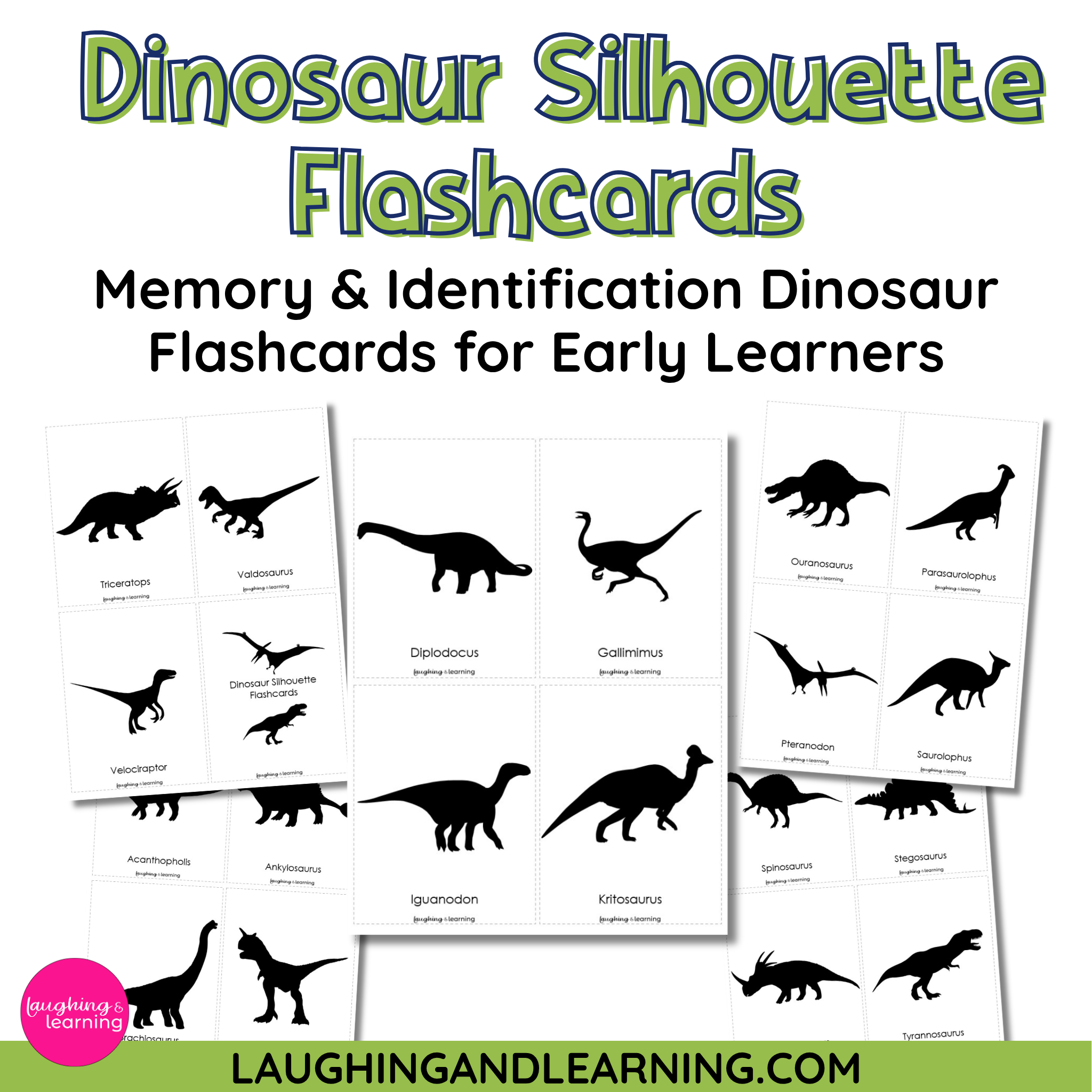
Dinosaur silhouette flashcards are printable cards that feature the bold black outline of a dinosaur species paired with its name. Rather than using illustrated or coloured images, the silhouette format challenges learners to identify each dinosaur purely by its body shape. This design choice is not just aesthetic – it actively builds visual discrimination, which is a key cognitive skill in early childhood development.
This particular set from Laughing and Learning includes 19 dinosaur species, covering a wide range of body types and prehistoric eras. From the unmistakable three-horned Triceratops to the long-necked Brachiosaurus and the sail-backed Spinosaurus, the cards introduce children to a diverse cast of prehistoric creatures. Each card clearly displays the dinosaur’s name below the silhouette, making it accessible for both pre-readers (with educator support) and early readers working on their own.
Why Silhouettes Work So Well for Young Learners
At first glance, a black silhouette might seem like a simplified version of a “real” dinosaur card. In practice, it is actually the more demanding – and more rewarding – format. Here is why.

When children look at a coloured illustration, their attention is drawn to details like colour, texture, and pattern. A silhouette strips all of that away and forces the learner to focus on shape alone. This trains the brain to notice structural differences: the curved neck of a sauropod versus the stocky body of an ankylosaur, or the wingspan of a Pteranodon versus the upright posture of a Velociraptor.
This kind of visual thinking builds a foundation for science skills that go far beyond dinosaurs. Sorting by shape, identifying patterns, and comparing physical characteristics are all skills children will use in biology, earth science, and beyond. The silhouette format also lends itself naturally to guessing games, which keeps engagement high without requiring special materials or complicated setup.
Learning Benefits Across Multiple Domains
One of the strengths of dinosaur silhouette flashcards is that they touch on several developmental domains at once – which makes them easy to justify whether you are a teacher planning curriculum or a parent looking for screen-free enrichment.

Science and Knowledge of the World – Children learn the names and distinguishing features of 19 real dinosaur species. They begin to understand that prehistoric animals came in radically different shapes and sizes, which lays early groundwork for concepts like adaptation and biodiversity.
Language and Communication – Dinosaur names are long, multi-syllabic words. Practicing how to say “Parasaurolophus” or “Acanthopholis” builds phonological awareness and gives children confidence with scientific vocabulary. This is genuine vocabulary enrichment, not just trivia.
Cognitive and Executive Function – The identification task requires working memory and visual recall. As children revisit the cards over time, they strengthen their ability to hold and retrieve information — a foundational executive function skill.
Positive Learning Behaviours – Because dinosaurs are inherently exciting, children approach these cards with curiosity rather than obligation. That intrinsic motivation supports engagement, persistence, and a healthy attitude toward learning new things.
How to Use the Flashcards: Core Activity and Extensions
The simplest way to use dinosaur silhouette flashcards is the direct identification activity. Hold up a card, invite the child to study the silhouette, and ask: “What dinosaur do you see on this card?” Younger or less experienced learners can start by pointing out features they notice before attempting to name the species. A prompt like “Does this dinosaur have a long neck or horns?” gives them a scaffold without giving the answer away.
From there, the possibilities expand quickly.

Matching Game – Print two copies of the cards. Place them face down in a grid and play a classic memory matching game. Children flip two cards at a time, trying to find the matching pair. This is an excellent centre activity that can run independently once children understand the rules.
Dinosaur Sorting – Invite learners to group the cards by physical features: long-necked dinosaurs, horned dinosaurs, flying dinosaurs, and so on. This open-ended classification activity naturally sparks discussion and comparison.
Pocket Chart Display – Arrange a selection of cards on a pocket chart or table. Ask children to compare the shapes: “Which two dinosaurs look the most similar? Which looks the most different?” This works especially well for small group discussion.
Guess the Dinosaur – Describe a dinosaur’s features without showing the card, and have children listen and guess which species is being described. This reverses the activity in a fun way and reinforces language alongside identification skills.
Research Extension – For more advanced learners, use each card as a jumping-off point for independent research. The child selects a card, finds out one interesting fact about that species, and shares it with the group. This bridges the flashcard activity to literacy and inquiry skills.
Recommended Age and Classroom Fit
These dinosaur silhouette flashcards are designed for children ages 4 to 8, making them appropriate for preschool, junior kindergarten, kindergarten, and early elementary classrooms. They also work well in home settings for this same age range.
For beginning learners, the focus stays on recognizing familiar shapes and building comfort with the card format. Developing learners can start reading and repeating the dinosaur names. Advanced learners can move into describing features, comparing species, and eventually researching independently. This natural differentiation means a single set of cards can serve a mixed-ability classroom without requiring separate materials.
Preparation is minimal. Print on cardstock, laminate for durability, and cut along the printed guidelines. The cards can be stored in a flashcard ring, a science centre bin, or a simple resealable bag. Once they are laminated, they hold up well through repeated use.
Making the Most of These Cards at Home

For parents, dinosaur silhouette flashcards are a wonderfully flexible tool. They take up almost no space, require no battery or screen, and can be picked up and put down easily. A few cards during a car ride, a quick round of the matching game before dinner, or a sorting activity on a rainy afternoon – these cards fit into real family life without becoming a project.
They also open up conversations that go beyond the cards themselves. Questions like “Which dinosaur would you least want to meet?” or “Which one do you think was the smartest?” invite imaginative thinking and storytelling alongside the science content. That combination of factual learning and open-ended play is exactly what makes a resource genuinely useful at home.
A Resource Worth Keeping

Dinosaur silhouette flashcards are the kind of teaching resource that earns their place in a collection. They are grounded in developmentally appropriate skills, flexible enough to grow with the learner, and built around a topic that children return to again and again. Whether you use them as a science centre staple, a rainy-day activity, or a structured vocabulary-building tool, they deliver consistent value with very little prep.
Download Your Dinosaur Silhouette Cards
If your learners are ready to roar their way through prehistoric science, this is a great place to start.
Looking for More Hands-On Activities?
If your learners enjoy this dinosaur activity, you will find many more hands-on resources in the Laughing & Learning shop. Happy learning!
If you use this in your classroom or at home, I’d love to hear how it went! Drop a comment below or tag me on Instagram. 🌸