
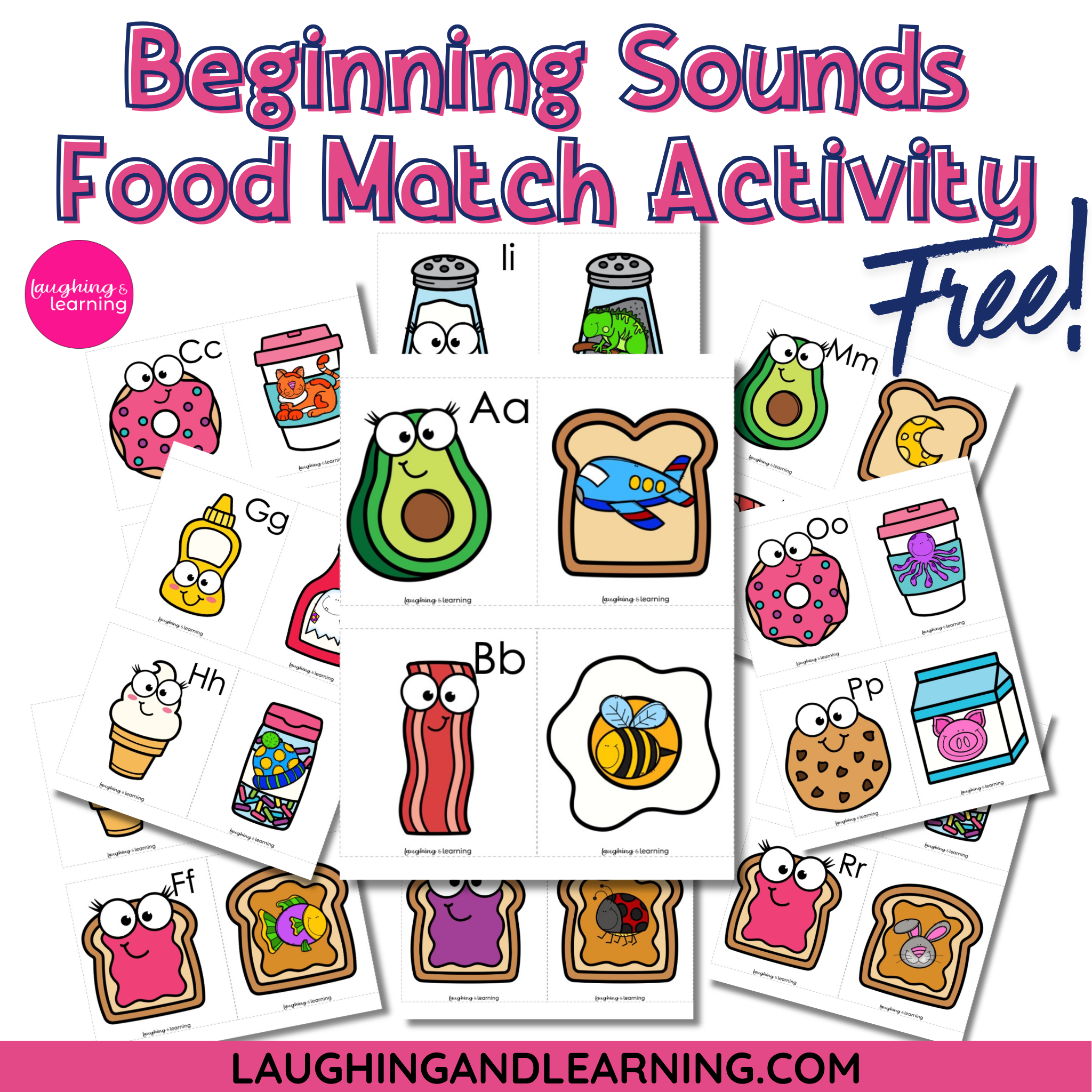
Want a beginning sounds activity that your learners will actually be excited about? These Food Pairs Beginning Sound Matching Cards are a clever, food-themed phonics activity that makes practising initial sounds genuinely fun. Each pair features a quirky, illustrated food character alongside a matching card hiding a secret object. Children match them together by identifying the beginning sound. Best of all, they cover every letter from A to Z and are completely free to download!
Whether you are a teacher building out your literacy centre or a parent looking for a playful phonics activity at home, these beginning sound matching cards for preschool are low-prep, visually engaging, and perfect for ages 3–6.

What’s Included
- 26 food-themed beginning sound matching card pairs covering A–Z
- Each pair features an illustrated food character showing the letter and a matching food container card hiding an object that starts with the same sound
- Bright, engaging illustrations throughout
- Ideal for preschool, pre-K, and kindergarten learners
Why Beginning Sounds Are the Foundation of Early Reading
Before children can read independently, they need to understand that words are made up of individual sounds. This concept, known as phonemic awareness, is one of the strongest predictors of future reading success. Specifically, the ability to identify the beginning sound of a word, also called the initial sound, is one of the very first phonemic awareness skills children develop.
When a child looks at an avocado and recognizes that it starts with the same sound as “airplane,” they are making a crucial connection between spoken language and the alphabet. Over time, these connections form the building blocks of decoding. The ability to sound out unfamiliar words independently. As a result, activities that practice beginning sounds consistently and playfully are among the most valuable things you can offer young learners.

These food-themed beginning sound matching cards for preschool take this essential practice and wrap it in something irresistible. Adorable food characters, hidden objects, and the satisfying click of finding the right pair.
How the Activity Works
The concept is simple, which is exactly what makes it so effective for young learners. Each letter of the alphabet has two cards. The first card shows a fun, illustrated food character. For example, a smiling avocado for the letter A, or a cheerful bacon strip for B. The second card shows the food pair with a surprise object hiding inside that starts with the same letter. An airplane tucked into a piece of toast for A, a bee nestled inside an egg for B, a cat curled up in a coffee cup for C.
Children look at the food character card, identify the letter and its beginning sound, and then find the matching food card by listening for the same sound at the start of the hidden object’s name. Additionally, encouraging learners to say the names of both objects aloud deepens the phonemic awareness practice and makes the matching process more meaningful.

Skills These Beginning Sound Matching Cards Build
These cards do far more than practice letters. In fact, they support several key areas of early development at once.
Phonemic Awareness: Identifying beginning sounds, connecting spoken words to their initial letters, and recognising that different words can share the same starting sound are all critical early literacy skills reinforced through this matching activity.
Letter Recognition: Each food character card clearly displays the uppercase and lowercase letter, giving children repeated exposure to letter forms in a context that feels playful rather than drill-like.
Vocabulary Development: The wide variety of objects hidden inside the food pairs, from iguanas to jellyfish to ghosts, introduces children to a rich range of vocabulary while they practice their phonics skills.
Cognitive Development: Finding the correct match requires visual discrimination, attention to detail, and logical thinking. Furthermore, the element of surprise created by the hidden objects keeps children curious and engaged throughout the activity.
Language and Communication: When children explain why two cards belong together. “Avocado and airplane both start with /a/!” They practice using phonics language in a natural, conversational way.

How to Use These Beginning Sound Matching Cards for Preschool
Core Activity: Find the Pair Spread all the cards face up on a flat surface. Children select a food character card, say the letter name and sound, and then search for the food container card whose hidden object starts with the same sound. Once they find the match, they set the pair aside and move on to the next letter. Encouraging learners to say both words aloud. “Avocado… airplane. They both start with /a/!”, reinforces the phonics connection with every pair they find.
Literacy Centre Place the mixed cards in a bin or basket in your literacy centre for independent matching practice. This activity works beautifully as a self-directed centre task, since the colourful illustrations provide strong visual cues that support independent work.
Small Group Instruction Use a smaller selection of cards. Perhaps just five to eight letters at a time, for guided small group practice. This gives you the opportunity to model sound isolation, prompt discussion, and observe which letter-sound relationships each learner has mastered.

Morning Bins These beginning sound matching cards for preschool make an excellent morning bin activity. The food theme is immediately eye-catching, which means children settle in and engage quickly, a great way to start the day on a positive, focused note.
Partner Play Pair learners together and let them take turns picking a card and finding its match. This peer-to-peer format naturally sparks conversation and gives children the chance to explain their thinking to each other, which deepens understanding for both partners.
Preparation Tips
Getting these cards ready takes very little time. First, print the cards on cardstock for the best durability. Then, laminate them for long-term use (laminated cards survive sticky fingers, bending, repeated sorting, and years of enthusiastic use). Finally, cut the cards apart and store them in a labelled bin, ziplock bag, or on a binder ring for easy access. If you prefer a no-laminate option, simply print on cardstock and replace as needed throughout the year.
Differentiation for Every Learner
Beginning Learners: Start with just five to six letter pairs. Particularly those with clear, easy-to-hear sounds like A, B, M, S, and T. Work through the matching process together, saying each word slowly and listening for the first sound.
Developing Learners: Use a larger selection of cards and encourage independent matching. Prompt learners to say both words aloud before confirming their answer.
Advanced Learners: Challenge children to sort the cards into alphabetical order after matching, or ask them to think of additional words that start with each letter sound. Both extensions deepen phonemic awareness and alphabet knowledge.
Download Your Free Beginning Sound Matching Cards
Grab your free food-themed beginning sound matching cards for preschool today and make phonics practice something your learners look forward to every single day!

Looking for More Spring Activities?
If your learners loved this beginning sounds activity, you’ll find even more resources in the Laughing & Learning shop! From printable worksheets to hands-on literacy and math activities, there’s something for every learner.
If you use this in your classroom or at home, I’d love to hear how it went! Drop a comment below or tag me on Instagram. 🌸