
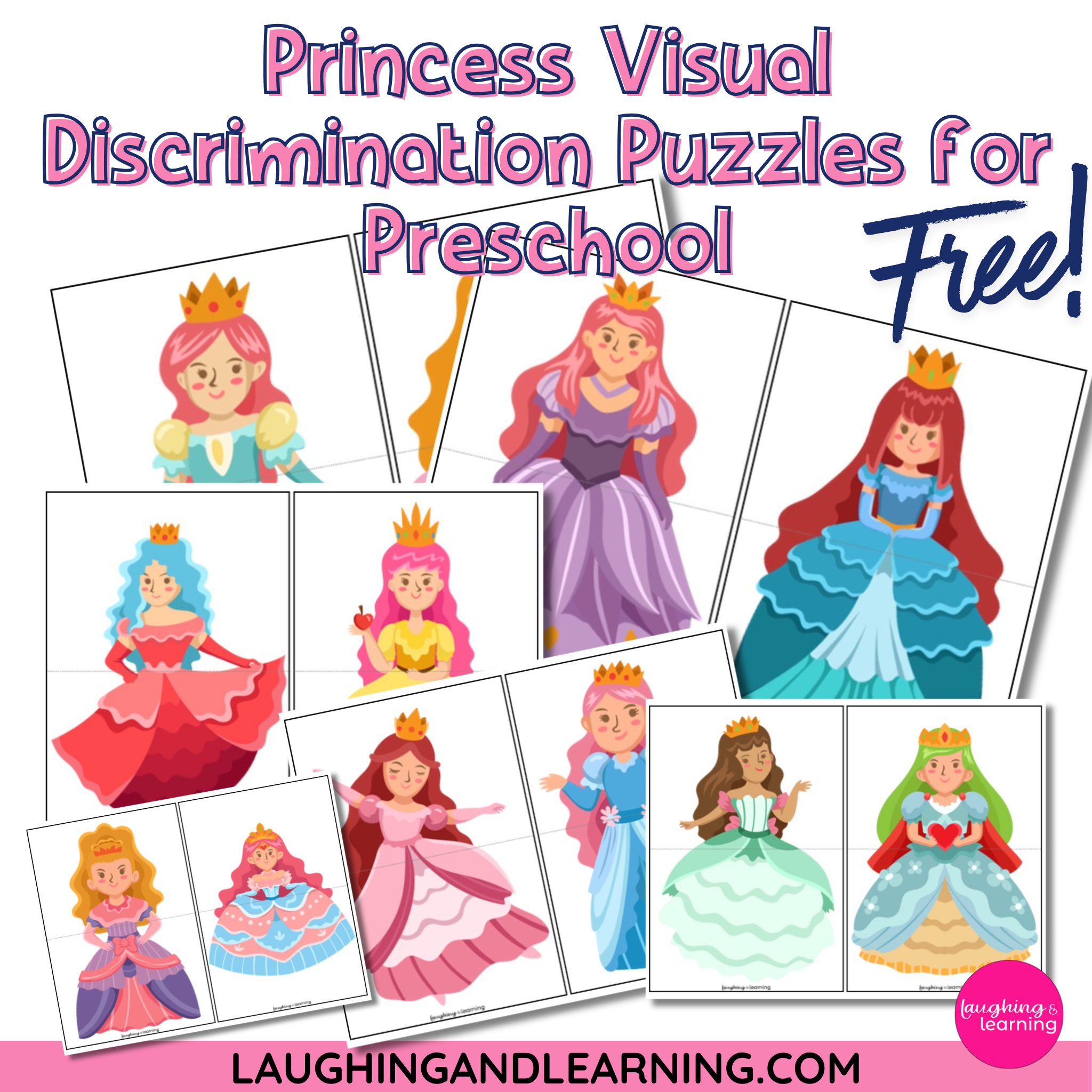
Do your little learners love all things princess? These Princess Visual Discrimination Puzzles are a gorgeous, hands-on activity that builds essential visual thinking skills through play. Featuring beautifully illustrated princess images in two levels of difficulty, these princess visual discrimination puzzles for preschool are perfect for fine motor centres, puzzle stations, and morning tubs. And the best part, they’re completely free!
Whether you’re a teacher looking for a themed activity that quietly does serious developmental work, or a parent wanting to keep little ones engaged at home, these puzzles are low-prep, reusable, and loved by children ages 3–6.
What’s Included

- 12 princess visual discrimination puzzles across two levels
- Level 1 (pages 1–6): 2-piece puzzles. Full princess images split into top and bottom halves
- Level 2 (pages 7–12): 4-piece puzzles. Increased complexity requiring more precise matching
- Ideal for ages 3–6 | Preschool | Pre-K | Kindergarten
Why Visual Discrimination Is an Essential Early Skill
Visual discrimination is the ability to notice similarities and differences between shapes, colours, patterns, and images. It sounds simple, but it is one of the most important skills young children can develop, and one that is often overlooked in early learning settings.
Children who struggle with visual discrimination often find it harder to distinguish between similar letters like b and d, or p and q. They may also find it difficult to recognise numbers, match shapes, or notice patterns. These are all foundational skills for reading and mathematics.
The good news is that visual discrimination improves significantly with practice. Activities like these princess visual discrimination puzzles for preschool make that practice feel like pure fun. When a child studies a princess image, notices the colour of her dress, the shape of her crown, and the details of her sleeves, and then finds the piece that matches precisely, they are actively strengthening the visual processing skills they will rely on for years to come.
Skills These Princess Visual Discrimination Puzzles Build

These puzzles are designed to support multiple areas of development at once, making them a high-value addition to any preschool or kindergarten setting.
Cognitive Development: Visual discrimination, attention to detail, problem solving, and spatial awareness are all called upon as children study each puzzle piece and determine where it belongs.
Executive Function: Completing a puzzle requires planning, sequencing, and organizing important thinking skills that support learning across every subject area.
Fine Motor Development: Picking up, rotating, and placing puzzle pieces builds hand strength, finger dexterity, and hand-eye coordination. The same skills children need for writing and drawing.
Language and Communication: Encourage children to describe what they see as they work, the colours, shapes, and features of each princess. This builds vocabulary and strengthens observational language in a natural, engaging context.
Positive Learning Behaviours: Puzzles naturally encourage persistence and independent task completion. The satisfaction of fitting pieces together correctly builds confidence and a positive relationship with learning challenges.
How to Prepare Your Princess Visual Discrimination Puzzles

Getting these princess visual discrimination puzzles for preschool ready is quick and straightforward. Here’s how to set them up for lasting use:
Print on cardstock. Cardstock gives the puzzle pieces the weight and firmness they need to be handled easily, especially by younger learners working on their fine motor skills.
Laminate for durability. Laminating the pieces before cutting means they can be used repeatedly without wear and tear. Most office supply stores offer inexpensive laminating if you don’t have a laminator at home.
Cut carefully along the puzzle lines. Clean, accurate cuts along the puzzle lines ensure the pieces fit together satisfyingly, which is a big part of what makes the activity rewarding for children.
Organise by level. Keep Level 1 (2-piece) and Level 2 (4-piece) sets in separate labelled bags or containers so you can easily match the right level to each learner.
How to Use These Princess Visual Discrimination Puzzles for Preschool
Core Activity: Complete the Princess Puzzle Children select puzzle pieces, study the visual details (colours, shapes, clothing, features) and assemble the pieces to complete the princess image. Encourage them to use visual clues like the colour of the dress or the style of the crown to guide their matching. For younger learners, prompt with “What colours do you see?” and “Which piece looks like it belongs here?”
Fine Motor and Puzzle Centre Place mixed puzzle pieces in a bin and let children work independently. These princess visual discrimination puzzles are ideal for a self-directed puzzle centre and provide rich, quiet, focused activity time.
Small Group Instruction Use the puzzles with a small group to guide observation skills and model how to look carefully at visual details. Prompt discussions with “What do you notice about this picture?” and “How do you know it fits?”
Visual Discrimination Centre Set these up as a targeted visual discrimination activity for learners who need extra support with visual processing. The two levels allow you to tailor the challenge to each child’s current ability.
Morning Tubs These puzzles make a wonderfully calm and engaging morning tub activity. Children can settle in, focus, and start the day with the quiet satisfaction of completing something independently.
Variations and Extensions

Match and Describe: After completing each puzzle, ask children to describe the princess, her dress colour, crown style, hair colour. This extends the activity into language development territory.
Memory Match: Turn all pieces face down and take turns flipping them over to find matching pairs This will add a memory and recall challenge to the activity.
Puzzle Challenge: Mix pieces from multiple princess puzzles together for a more complex sorting and matching challenge. This is great for advanced learners who need an extra push.
Create Your Own: As a creative extension, children draw their own simple picture, cut it apart, and challenge a friend to put it back together.
Differentiation for Every Learner
Beginning Learners: Use 2-piece puzzles only and offer one puzzle at a time to avoid overwhelm. Work alongside the child, pointing out visual clues together.
Developing Learners: Introduce mixed sets of 2-piece puzzles and encourage independent matching with minimal prompting.
Advanced Learners: Use the 4-piece puzzles mixed together and challenge learners to explain their reasoning. Like, “How do you know that piece goes there?” This deepens both thinking skills and language development.
Helpful Teacher Talk Prompts
- “What do you notice about this picture?”
- “What colours do you see?”
- “Which piece matches here?”
- “How do you know it fits?”
- “Can you describe the princess?”
Download Your Free Princess Visual Discrimination Puzzles

Grab your free princess visual discrimination puzzles for preschool today and bring a little royal magic to your fine motor and puzzle centres!
Looking for More Spring Math Activities?
If your learners loved these princess visual discrimination puzzles for preschool, check out more hands-on math and literacy resources in the Laughing & Learning shop. There’s something for every learner at every stage.
If you use this in your classroom or at home, I’d love to hear how it went! Drop a comment below or tag me on Instagram. 🌸