
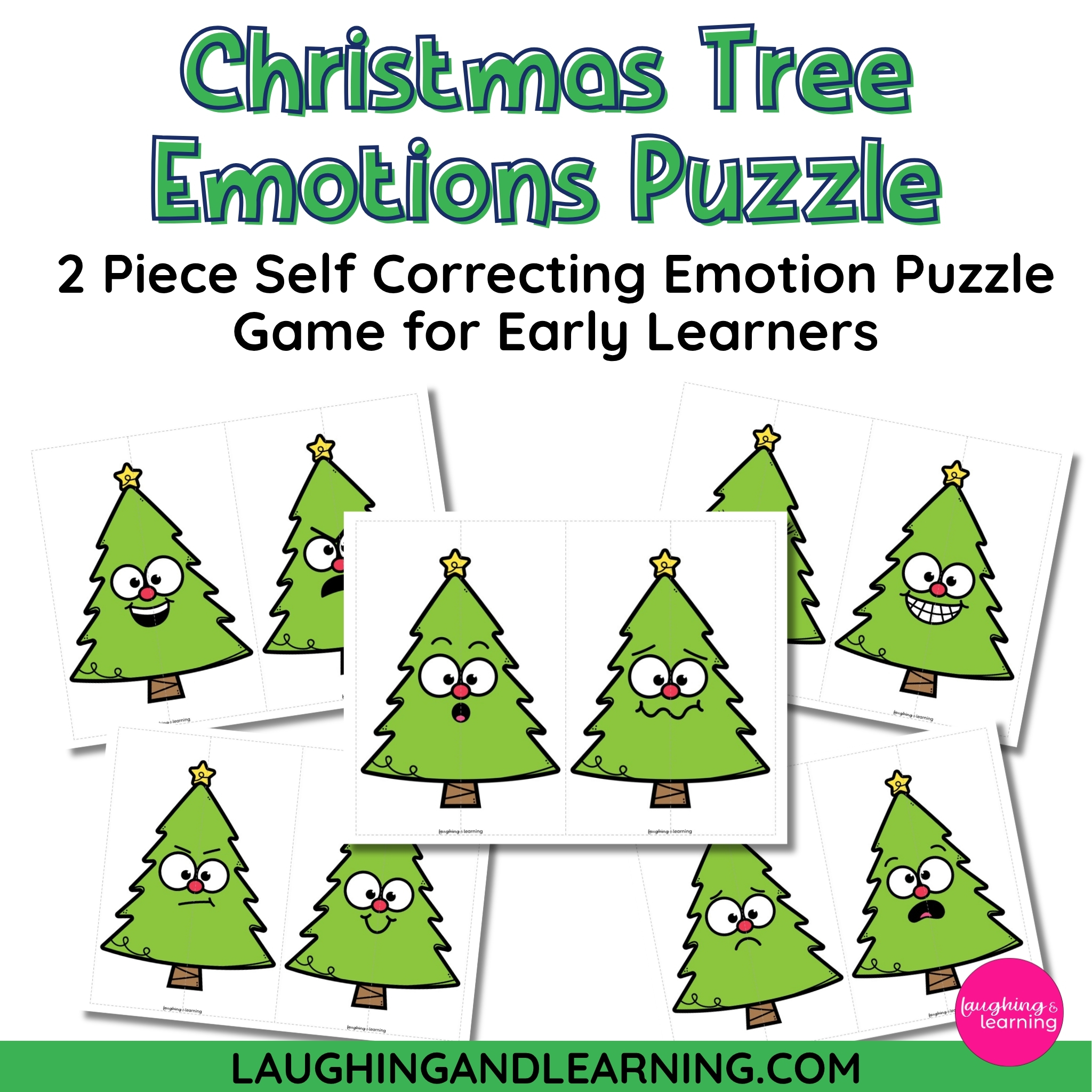
The weeks leading up to Christmas are full of twinkling lights, excitement, and change in routine. They can also stir up big feelings that young children are still learning to name. The Christmas tree emotions puzzle gives children a playful way to explore those feelings. Each two-piece puzzle splits a smiling Christmas tree face right down the middle. Children join the matching halves to reveal one clear expression, then talk about what that feeling means to them.
This self-correcting design means children can work independently and see right away whether their pieces fit. That instant feedback builds confidence and encourages children to keep trying without needing constant adult support. The puzzle works beautifully in a social-emotional learning center, a small group lesson, or a quiet independent task during a busy December.
What Is the Christmas Tree Emotions Puzzle

The Christmas tree emotions puzzle set includes ten self-correcting, two-piece puzzles shaped like a friendly Christmas tree. Each puzzle splits vertically into left and right halves. Only the correct matching half completes a clean, believable face. The set covers a wide range of expressions, including happy, sad, mad, surprised, silly, grin, worried, grumpy, and smirking.
Because each puzzle is self-correcting, children get instant visual feedback. A mismatched pair looks obviously wrong, while a correct match snaps together into a recognizable face. This design supports independent practice and frees up teacher time for observation and meaningful conversation rather than constant correction.
Ways to Use the Christmas Tree Emotions Puzzle

This puzzle set offers more than a single matching task. Try building a full routine around it using these approaches.
Match and talk- Children join the left and right halves to complete each tree face. After every match, encourage them to name the feeling and share a time they felt that way themselves.
Sort by feeling type- Once a child finishes assembling the puzzles, ask them to sort finished faces into groups like positive feelings and uncomfortable feelings. This builds early categorization skills alongside emotional awareness.
Mirror practice- Set a small mirror beside the puzzle station. Children can look at a completed tree face, then try making that same expression themselves.
Word card pairing- Add simple emotion word cards next to the matching puzzle pieces. This connects the visual expression to its written label, building early literacy alongside social-emotional skills.
Skills This Emotions Puzzle Builds
This activity was designed to reach several developmental areas at once, making it a strong addition to any preschool or kindergarten toolkit.

Facial expression recognition- Repeated exposure to varied tree expressions helps children notice small differences in eyebrows, eyes, and mouths.
Emotion vocabulary- Naming each feeling out loud builds a richer vocabulary for talking about emotions in everyday life.
Problem-solving and self-correction- When two halves do not match, children see the mismatch and try again. This builds persistence and independent thinking.
Fine motor development- Picking up small puzzle pieces strengthens pincer grip, while lining up the two halves builds bilateral coordination and hand-eye coordination.
Differentiation for Every Learner

Start small- Introduce just two or three emotion puzzles at first. Add more expressions once a child feels confident finding matches.
Add visual supports- Keep emotion word cards or simple face icons nearby for children who need extra cues. Remove these supports gradually as skills build.
Extend with conversation- For children ready for more challenge, ask open-ended questions like what helps them feel better when they are upset, or how they can tell someone else is happy.
Preparation Tips
- Print each Christmas tree emotions puzzle page on cardstock for durability.
- Laminate the pages if you want long-term, wipe-clean use.
- Cut along the outer dashed rectangles to separate each individual puzzle card.
- Slice down the dotted center line on each card to create the two matching halves.
- Store completed puzzle pieces in a labeled bin so the set stays organized between uses.
Why This Emotions Puzzle Works

Self-correcting materials give children the freedom to explore and make mistakes without feeling embarrassed or needing constant supervision. The Christmas tree emotions puzzle takes that proven approach and wraps it inside a favorite holiday symbol. Every completed match becomes a natural entry point for a real conversation about feelings, which helps children build the language they need for self-regulation and empathy.
Because the puzzle blends fine motor practice with social-emotional learning, it supports whole-child development in one simple resource. Teachers can use it throughout the holiday season, then bring it back year after year as a favorite classroom tradition.
Get the Christmas Tree Emotions Puzzle

Ready to add feelings recognition to your holiday centers? The Christmas tree emotions puzzle set is available now, complete with a full instruction sheet and trim guides for fast, simple prep.
Perfect for preschool, pre-K, and kindergarten classrooms serving children ages 3–6
Looking for More Festive Activities?
If your learners enjoy these Christmas Tree Emotions Puzzle, you will find many more hands-on resources in the Laughing & Learning shop. Happy learning!
If you use this in your classroom or at home, I’d love to hear how it went! Drop a comment below or tag me on Instagram. 🌸
Leave a Reply